|
Gilbert
& Sullivan
|
|
a
selling exhibition of memorabilia
|
|
ARCHIVE
|
|
|
|
Items on this page have mostly (but not exclusively) already sold. Although the main aim of this site is not to be educational, the programmes we have sold in the past form an interesting record of the work of Gilbert, Sullivan and D'Oyly Carte. Items are listed in date order, according to printing date of the item (where known) and hopefully this page will be of interest to researchers and collectors. Titles of items relating to just Gilbert appear in PINK, Sullivan's works are in BLUE and joint works are GREEN. London opening night dates are given in purple. Early items which are currently for sale will be found here on the site. |
| 1863 |
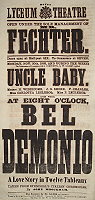 |
UNCLE BABY What is generally believed to have been Gilbert's first produced play, Uncle Baby, was a curtain raiser to John Brougham's drama Bel Demonio at the Royal Lyceum Theatre. It opened on 31st October 1863, and was not well received by the critics, which may explain why Gilbert conveniently forgot to mention it in later years. It had its final performance on December 19th, having run for only about 43 performances. This example of the programme dates from November 30th and is in the large double-page format typical of early British theatre bills. |
| 1869 |
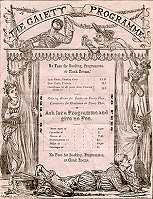 |
ROBERT THE DEVIL Gilbert's opera, Robert the Devil was the first production at the new Gaiety Theatre on 21st December 1868. This programme dates from January 30th 1869, when the piece was preceded by the curtain raisers On the Cards and The Two Harlequins. It includes a full page of extracts from London newspapers, reviewing both the venue and the entertainments. |
 |
ROBERT THE DEVIL By March 29th 1869, Robert the Devil was preceded by T.W. Roertson's play Dreams and The Two Harlequins. There had been a few minor changes in the cast, but the title role was still played by Nellie Farren. The piece ran until at least April 19th, but had definately been withdrawn by May 17th, so ran for less than 150 performances. |
| 1871 |
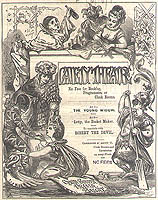 |
ROBERT THE DEVIL Robert the Devil was in fact a parody of Meyerbeer's opera Robert Le Diable and was the last in a series of three such burlesques. It was revived at the Gaiety Theatre many times. This programme dates from June 1871, when the piece followed a "new" arrangement of Balfe's, Letty, the Basket Maker. |
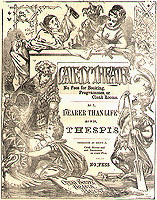 |
THESPIS The first Gilbert & Sullivan collaboration opened at the Gaiety Theatre on 26th December 1871. This early example of the programme was printed sometime before Jan 13th. The companion piece, Dearer Than Life, was replaced by Ganymede & Galatea and Off the Line on 20th January, and by Paul Pry on 26th February. Thespis closed on 8th March 1872 and was given just one revival, at Mdlle. Clary's benefit on 28th April 1872. |
| 1872 |
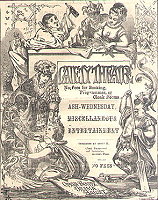 |
THESPIS INTERRUPTED Thespis ran for 63 nights, not 64 as often stated, as there was a one-night break in the run. Most London theatre managements declined to present a fully costumed performance on Ash Wednesday, in order to show respect for the start of Lent. Hollingshead therefore replaced Thespis on 14th February 1872 with a Miscellaneous Entertainment. By a remarkable coincidence George Grossmith (presumably the younger) gave a parody of a Penny Reading as part of a bill which also featured ventriloquists and performing dogs ! |
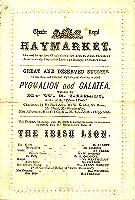 |
PYGMALION & GALATEA Gilbert's Pygmalion & Galatea opened at the Theatre Royal Haymarket on December 9th 1871. This programme is for the 40th performance, on January 25th 1872; Mr Kendal and Miss Robertson in the title roles. The play was preceded by a Buckstone farce, The Irish Lion, and followed by Charles Mathhews' farce, Uncle Foozle. |
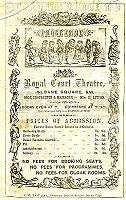 |
CREATURES OF IMPULSE This Gilbert play first opened at the Royal Court Theatre on 2nd April 1871. Edward Righton recreated his role of the miser Boomblehardt, in this revival, from October 1872, although most of the cast is different from that seen at the premiere. Interestingly, it is still described as a "New Fairy Tale". |
 |
PYGMALION & GALATEA The author sanctioned a tour of Pygmalion & Galatea by L. J. Sefton's London Comedy Company, the production reaching Worcester on 26th December 1872, where it played for nine nights. The programme includes many quotes from reviews, and gives details of the afterpiece, F. C. Burnand's King Kokatoo!. |
| 1873 |
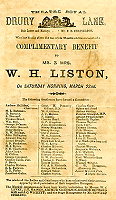 |
W.H. LISTON BENEFIT Gilbert's "fairy comedy", The Wicked World, had opened at the Haymarket Theatre on 4th January 1873, but one scene was performed at the Theatre Royal Drury Lane on March 22nd of the same year for the benefit of Mr and Mrs W. H. Liston. Gilbert sat on the steering committee for the event, as did Charles Dickens and many other great names of British theatre . Henry Irving appeared in a scene from Charles I. |
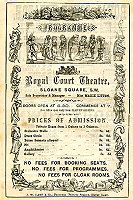 |
THE HAPPY LAND Written under a pseudonym, F. Tomline, with Punch writer Gilbert A'Beckett, W.S. Gilbert burlesqued his own play, The Wicked World, in his satrirical piece, The Happy Land, which opened at the Royal Court Theatre on March 3rd 1873. This programme dates from some time after March 6th, when the names of the "mortals" were changed, in order to disguise the portrayal of Gladstone and other leading politicians. In an interesting note in the programme, Gilbert has given permission to his alter ego to pastiche his own work ! |
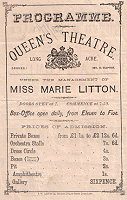 |
CREATURES OF IMPULSE Gilbert's Creatures of Impulse was revived at Queen's Theatre in 1873, this programme dated by hand for July 8th of that year. Part of a triple bill with Vesta's Temple and Jerrold's Black-Ey'd Susan, the Gilbert play still featured Edward Righton in his original role as Boomblehardt. The back page has an advert for the Royal Court, where Gilbert's The Happy Land was still playing. |
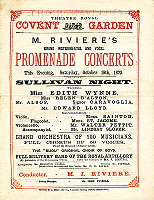 |
SULLIVAN NIGHT Even before Trial by Jury, Sir Arthur was an established enough composer to be afforded his own night at the Covent Garden proms. October 18th 1873 was "Sullivan Night", and the entire first half of the concert was composed of his work, conducted by the man himself. As well as songs (including "Little Maid of Arcadee" from Thespis, the audience heard the Tempest and Merchant of Venice material, the Cello Concerto and the "Overturo di Ballo". |
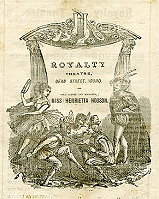 |
THE REALM OF JOY The Realm of Joy by Gilbert (but written under the pseudonym of F. Latour Tomline) opened at the Royalty Theatre on 28th October 1873. This programme is from November 4th, soon before the title of the piece was changed to The Realms of Joy. |
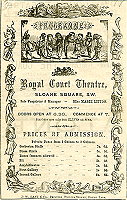 |
THE WEDDING MARCH Gilbert's play The
Wedding March, also written under his pseudonym, F. Latour Tomline,
opened at the Royal Court Theatre on November
15th 1873, and settled in for a good run. This programme is from
about a month after the opening night, as it is dated 18th December,
but the play ran until at least March 1874. It was definately withdrawn
before 20th May 1874. |
| 1874 |
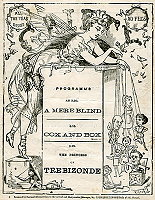 |
COX & BOX Possibly a previously unrecorded performance of Cox & Box, this production appeared at the Gaiety Theatre during the week of Sept 7th 1874. The composer's brother, Frederic Sullivan, played Cox, with Arthur Cecil as Box and J.G. Taylor as Bouncer. The evening commenced with Offenbach's A Mere Blind and ended with the 2nd and 3rd acts of the same composer's The Princess of Trebizonde. |
| 1875 |
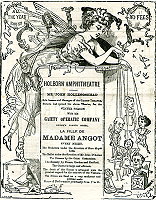 |
MERRY WIVES OF WINDSOR Arthur Sullivan composed "new and original music" for the last act of a production of Shakespeare's The Merry Wives of Windsor which opened at the Gaiety Theatre on December 19th 1874. The words to an interpolated song for Anne Page were set by Algernon Swinburne. This programme, dated 29th January 1875, also credits Sullivan with having selected the chorus of children which sang in the piece. |
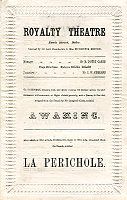 |
TRIAL BY JURY announced Trial By Jury is announced in this programme from the Royalty Theatre dated 2nd February 1875. The notice reads, "In preparation, a New Comic Opera, composed expressly for this Theatre, by Mr Arthur Sullivan, in which Madame Dolaro and Miss Nelly Bromley will appear". In the event of course, although Selina Dolaro would continue to play the title role in La Perichole there was to be no role for her in Trial by Jury. Richard D'Oyly Carte's name appears on the cover, as "manager" of the theatre. |
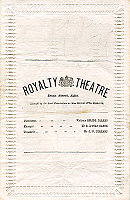 |
TRIAL BY JURY Trial By Jury opened at the Royalty Theatre on 25th March 1875, playing as an afterpiece to Offenbach's La Perichole. The true initial run was rather short, as the theatre closed on June 12th, the company taking the production on tour. Although probably issued on 10th April 1875, it is possible that this programme was printed even earlier, as it does not mention the Associate, a role which is generally believed to have been named after 1st April. All the original cast members were in place at this exceptionally early date. |
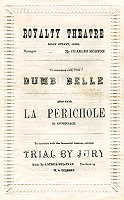 |
TRIAL BY JURY Following their tour, the Trial By Jury company re-opened at the Royalty Theatre on 11th October 1875, again playing with La Perichole. By the date of this programme, 16th November, there had been some substantial cast changes and the piece was now described as "successful". The operetta was withdrawn on 18th December, having totalled an initial, if fractured, run of 131 performances. |
| 1876 |
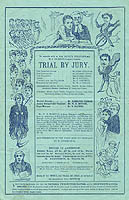 |
TRIAL BY JURY On January 13th 1876 the production moved to the Opera Comique, where it was initially an afterpiece to Offenbach's Madame L'Archiduc. This Opera Comique programme, dated 14th February 1876, features the composer's brother Fred Sullivan in his original role as the Judge. Counsel, Usher and Foreman were all played by actors who had appeared at the Royalty. Gilbert and Sullivan appear on the cover and the programme is full of line drawings of characters in both pieces. |
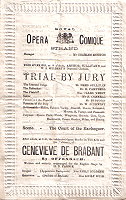 |
TRIAL BY JURY During the 96 performance run of Trial by Jury at the Opera Comique it shared the bill with three different operettas. On this programme it was forepiece to Offenbach's Genevieve de Brabant, starring Emily Soldene, which dates it to between 18th March and April 1st 1876. Fred Sullivan was still The Judge and understudy "E. Cambell" (Charles ?) was The Defendant. Foreman was W.S. Penley, later famous in the title role of Charley's Aunt. |
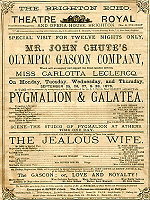 |
PYGMALION & GALATEA on tour Gilbert's 1871 play Pygmalion & Galatea reached Brighton's Theatre Royal on 25th September 1876, performed by John Chute's Olympic Gaston company, and starring John Nelson and Carlotta Leclercq. |
| 1877 |
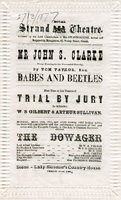 |
TRIAL BY JURY Trial By Jury was first revived on March 3rd 1877 at the Strand Theatre, as afterpiece to Tom Taylor's Babes and Beetles and Charles Matthews' The Dowager. After the first two weeks George Leith took over the role of Judge from J.G. Taylor, but otherwise the cast remained the same for the whole of the 73 performance run. This programme is dated for 27th March 1877. |
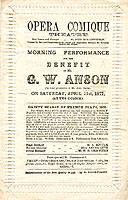 |
ANSON BENEFIT On April 21st 1877, at 2pm, the Opera Comique hosted a benefit performance for the actor G.W. Anson. Of most interest to us here is the appearance of Lionel Brough singing a new musical sketch by George Grossmith (then "Junr.", but our Gee Gee), "The Muddle Puddle Junction Porter". Earlier in the afternoon Ellen Terry appeared as Helen in a scene from Knowles' The Hunchback. |
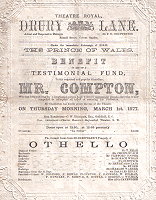 |
COMPTON BENEFIT Trial By Jury was the highlight of Mr. Compton's benefit at Drury Lane on March 1st 1877. George Honey was Judge, leading a distinguished cast which included George Grossmith as a juryman, making what was probably his first appearance in a Gilbert and Sullivan opera, almost nine months before the opening of The Sorcerer. Sullivan conducted the orchestra, but no actor is credited with the role of Associate, leaving open the possibility that this was Gilbert, which would make this one of the very rare occasions when G&S appeared together in public. |
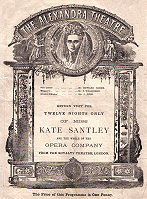 |
PRINCESS TOTO on tour Princess Toto, a comic opera by W.G. Gilbert, with words by Frederic Clay had opened in Nottingham on June 26th 1876, making a short tour of the UK before opening at the Strand Theatre on 2nd October of that year. Produced by Kate Santley, who played the title role, Princess Toto ran for just 48 performances in London before setting out on tour again, reaching Liverpool for the second time on August 6th 1877. W.H. Seymour, who would be D'Oyly Carte's stage manager for twenty years from 1881, played Zapeter at the Alexandra Theatre and was joined in the cast by other key members of the Royalty Theatre company, including Amy Clifford who had appeared as First Bridesmaid in the first run of Trial by Jury. |
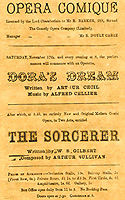 |
SORCERER - FIRST PROGRAMME The Sorcerer opened at the Opera Comique on 22nd November 1877, and it appears that no special programme was produced for opening night. However, this copy was issued during the first two weeks of the production, as it gives Act 2 as "Market Place in the Village", and has typographical errors consistent with the example reproduced by Reginald Allen, and which he considers likely to have been the first issued. This copy is dated for third night. |
| 1878 |
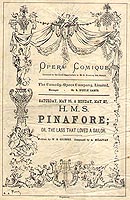 |
HMS PINAFORE- OPENING NIGHT H.M.S. Pinafore opened at the Opera Comique on May 25th 1878. This programme was intended for use on both the first and second nights and it bears both dates. Only five hundred were printed, and of these just a handful are known to have survived. |
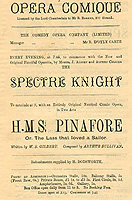 |
HMS PINAFORE- 3rd NIGHT This H.M.S. Pinafore programme is reliably dated in pencil for 28th May 1878, the third performance. This was the opening night of the first revival of the forepiece, Spectre Knight, and shows that Second Lady was played on this occasion by Miss Hervey, not Miss Muncey, as has been stated. |
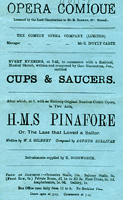 |
HMS PINAFORE This H.M.S. Pinafore programme is reliably dated in pencil for 7th August 1878, and is remarkable in that Ralph Rackstraw was played by a Mr Ferran, who is not listed in Rollins and Witts or any other source that we've seen, although this may be a mis-print for D'Arcy Ferris who played the role on occasion. Buttercup was Emily Cross, here appearing in the role much earlier than has been previously documented. |
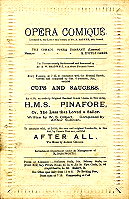 |
HMS PINAFORE During the run of H.M.S. Pinaforethere were occasional cast changes. This example probably dates from either August 1878 or February 1879, as Josephine is played by Alice Burville. |
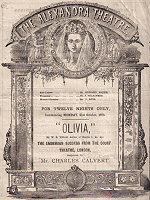 |
OLIVIA W.G. Wills' play, Olivia, opened at the Court Theatre in London on 30th March 1878, and included a Sullivan part-song, "Morn, happy morn". This programme, crediting Sullivan with the "trio" in Act Two, is from Liverpool, where the play appeared for twelve nights from 21st October 1878. |
| 1879 |
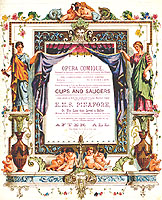 |
HMS PINAFORE Highly decorated programme featuring the original cast of Pinafore. The use of gold and full-colour litho would suggest that this was intended for use in only the very best seats, or at a special performance, although it is frustratingly undated. It must date from before the split between D'Oyly Carte and the Comedy Opera Company on 1st August 1879. |
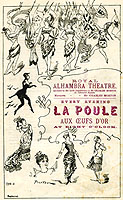 |
LA POULE AUX OEUFS D'OR A Sullivan curiosity ! This English version of a French "feerie" at the Alhambra boasted music by a number of composers including Rossini, Offenbach and one "A. Sullivan". It must be presumed that some of his themes were borrowed, presumably with his permission. The programme, dated 15th March 1879, includes illustration of scenes, and much detail of the settings and dances. Emily Soldene played Princess Fanfreluche. |
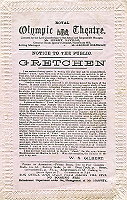 |
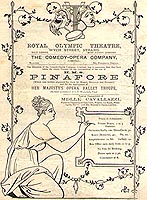
GRETCHEN One of the biggest flops of Gilbert's career, Gretchen, his play "suggested by the leading incidents in Goethe's Faust", opened at the Royal Olympic Theatre on March 24th 1879. It had closed by April 3rd, less than two weeks later. The cover of the programme carries a virtual essay by Gilbert anxious to explain to the audience that he was not attempting to put Faust on stage in its entirety, but simply to "re-model ... the story of Gretchen's downfall". |
 |
HMS PINAFORE (PIRATE PRODUCTION) On August 1st 1879 a rival production of Pinafore opened in London, produced by the Comedy-Opera Company. This programme dates between September 8th and October 25th, when the show was playing at the Royal Olympic Theatre. On the cover, the production company claim that the piece was written "expressly for them by Messrs. Sullivan and Gilbert" ! |
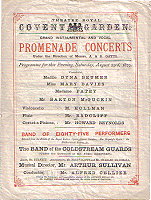 |
PINAFORE AT THE PROMS It is well known that during the first run of HMS Pinafore, Sullivan strategically programmed a selection from the piece in occasional Covent Garden promenade concerts, in what was an apparently successful attempt to boost sales of tickets at the Opera Comique.. On this occasion, Saturday August 23rd 1879, Sullivan was to have conducted, but it is noted that during his "temporary and unavoidable absence" Alfred Cellier would undertake his duties. The Pinafore selection was arranged by Hamilton Clarke. |
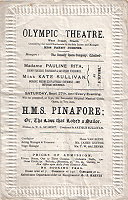 |
HMS PINAFORE (PIRATE PRODUCTION) The pirated Pinafore went through a staggering succession of cast members during its 91 performance run in two theatres. By 27th September 1879 the piece, at the Olympic Theatre, featured a pair of sopranos, Pauline Rita and Kate Sullivan, sharing the role of Josephine, playing alternate performances. Frederic Wood, as Ralph, is not listed in Rollins & Witts; and the programme also names Mr Dymott as Bob Beckett, the only actor from the original to take his chance with the producers of the rival production. |
 |
SWEETHEARTS Lydia Thompson's company appeared in Liverpool on 17th November 1879, where they played a triple bill for six nights, including Gilbert's Sweethearts starring Miss Thompson as Jenny, with Charles Vandenhoff as Harry. |
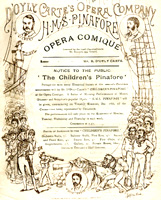 |
HMS PINAFORE Attractive H.M.S. Pinafore programme, with cover advert for The Children's Pinafore and dated in pencil for 13th December 1879. Many of the roles are played by cast members who would not be expected to appear at this date. Frank Thornton is Deadeye; Elinor Loveday is Josphine; Mr Montelli is Bobstay; Mr Ramsay is Beckett; and Haidee Crofton, Hebe. |
| 1880 |
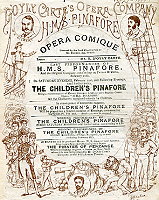 |
HMS PINAFORE The cover of this similar programme states that it was produced for the "last performances" of Pinafore. It is dated by hand for Feb 9th 1880. After 571 performances the piece closed on Feb 20th. Again, there are a few unexpected cast members, most notably Fanny Holland as Josephine. The programme is decorated inside and out with scenes from the opera, and includes many plugs for the Children's Pinafore and an announcement that Pirates is due to open "at Easter". |
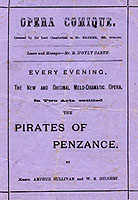 |
PIRATES OF PENZANCE The Pirates of Penzance was first seen in London at the Opera Comique on April 3rd 1880, where it ran for 363 performances, closing on April 2nd of the following year. This unusual programme printed on pale lilac paper, dates from before July 1880, as it features all the original London cast. |
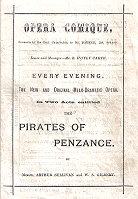 |
PIRATES OF PENZANCE An unusual programme for The Pirates of Penzance at the Opera Comique. Although it clearly dates from before July 1880, Ellen Shirley plays Mabel. A note explains that this actress would "sustain the part during Miss Hood's indisposition". This would therefore appear to represent Ellen's debut in a solo G&S role, at least 6 months earlier than previously recorded. Otherwise, the cast is that which had been seen on the London opening night. |
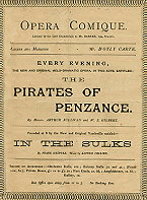 |
PIRATES OF PENZANCE This strange programme was probably printed in September 1880, and certainly after July, when some of the cast returned from New York, having created their roles in the States. It is unusual in that Frederic is played by one "F. Seymour". Was this W.S. Seymour, the Opera Comique stage manager who deputised for George Power on odd occasions during the run ? Billie Barlow, as Isabel, is credited as "M. Barlow". It is possible that her real initial has been used here in error, as she had only recently adopted the name Billie. |
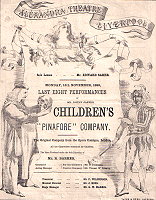 |
CHILDREN'S PINAFORE on tour The Children's Pinafore had opened at the Opera Comique on Dec 16th 1879, playing 78 matinees over the Christmas season. On August 2nd 1880 this company set out on tour, reaching Liverpool in November, where the final eight performances at the Alexandra Theatre were given following November 15th. Unlike in London, the children performed in the evening as well as at Wed and Sat matinees. The cast was as had been seen in London, except that Hebe was Alice Roe and Bob Beckett was played by Master R. Presano. |
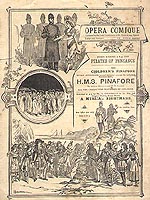 |
PIRATES OF PENZANCE The cover of this attractive programme includes an announcement for the revival of the Children's Pinafore to be played during the Christmas holidays, so it most likely dates from just prior to that production's December 22nd 1880 return to the Opera Comique. |
| 1881 |
 |
PIRATES OF PENZANCE / IN THE SULKS on tour D'Oyly Cartes "B" company arrived in Liverpool on 28th February, where they presented The Pirates of Penzance for two weeks. Half way through this engagement at the Alexandra Theatre the cast became known as "C" company. This was also a period of change-over among the lesser female roles, and during the first week (at least) Edith was Agnes Mitchell, Kate was Lucy Millais and Isabel was Ethel Maribel. In the curtain raiser, In The Sulks, Louis Herbert played Liverby, Lucy Millais his wife and Joseph was W. T. Hemsley. |
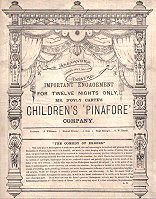 |
CHILDREN'S PINAFORE on tour The Children's Pinafore set out on tour again after the second Christmas season of matinees at the Opera Comique ended on January 28th (or Feb 11th ?) 1881. Despite this being a short tour, ending on July 2nd, the company returned to Liverpool for a twelve-night engagement from 30th May 1881. There were more cast changes from the original Opera Comique production, with George Coburn as Ralph and Edith Stanfield as Hebe. By this time Bob Becket was now Anthony Presano while (his brother ?) R. Presano had moved across to play Bill Bobstay. It is interesting that in both Liverpool programmes Sir Joseph is played by "James E. Pickering", while in London he had been listed as Edward. |
 |
PATIENCE / UNCLE SAMUEL Patience opened at the Opera Comique on April 23rd 1881, where it played for 170 performances before closing on October 8th, ready to reopen immediately at the new Savoy. This programme, dated 6th May 1881, is for the complete original cast, before Richard Temple was replaced in September, and includes the following notice: "The music will be published in a few days. Orders taken by the attendants will be executed post free on the day of publication". The forepiece, Uncle Samuel, had premiered on 3rd May 1881. |
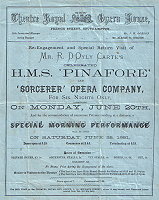 |
PINAFORE / SORCERER on tour The D'Oyly Carte "B" Company arrived at the Theatre Royal Opera House in Southampton on 20th June 1881, presenting H.M.S. Pinafore on Monday, Friday and Saturday evenings, and The Sorcerer on Tuesday, Wednesday, Thursday and Saturday afternoon. Each performance was preceded by In the Sulks. The programme also carries an announcement that the Children's Pinafore would be appearing at the theatre for a week from June 27th 1881. |
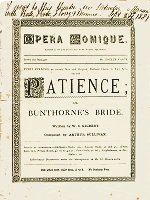 |
PATIENCE This programme, dated September 24th 1881 shows no forepiece as it was for a matinee performance. The cast is as opening night, but with one important exception: Ellen Shirley in the title role. Although the programme states that this was her first appearance at this theatre, she had actually filled in for Marion Hood as Mabel on occasion in the previous January. |
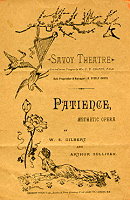 |
PATIENCE / MOCK TURTLES Patience transferred to the new Savoy Theatre on 10th October 1881. Programmes are hard to date accurately, as we have to rely on dates written in by the original theatregoers. To add to the confusion, the programmes were printed in at least two designs and in many colour variations. This paper one, issued to those sitting in the cheaper seats, was originally bright orange paper but has since faded to beige.
|
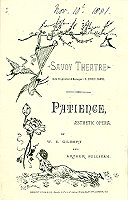 |
PATIENCE / MOCK TURTLES The curtain raiser, Mock Turtles, was probably added to the bill around 15th November 1881, with Courtice Pounds creating the role of Mr. Wranglebury. This pale green cardboard programme, printed in iridescent green ink, is dated in pen "Nov 10th 1881" but this is probably a mistake - 1882 is much more likely as Arthur Law plays Wranglebury. Walter Browne appears as the Colonel; otherwise the Patience cast is as opening night. |
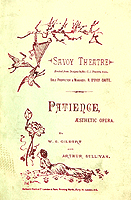 |
PATIENCE / MOCK TURTLES This programme is similar, though decorated with scenes from the opera in iridescent red ink. Printed on card, it would have been given to those in more expensive seats. Patience ran for a further 408 performances at the Savoy, closing on November 22nd 1882 after a total run of 578 performances. |
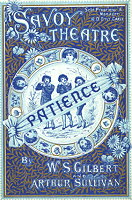 |
PATIENCE / MOCK TURTLES One of the best designed decorative souvenir programmes we have seen, presumably produced to mark a special occasion, or possibly just for those sitting in boxes. Walter Browne played the Colonel. Printed in blue and gold, the cover depicts the military men in aesthetic guise in the centre of a blue and white china plate, while the inside has four vignettes from the opera and the portrait heads of Gilbert & Sullivan. The rear cover has an advert for the vocal arrangements. |
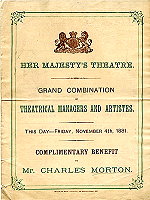 |
CHARLES MORTON BENEFIT On Friday November 4th 1881 Her Majesty's Theatre was host to a benefit for Charles Morton by a "grand combination of theatrical managers and artistes". Cellier conducted Leonora Braham and Rutland Barrington in a scene and duet from Patience. The rest of the bill was a mix of serious and light-hearted pieces and musical hall turns. |
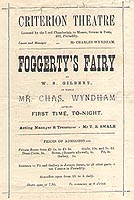 |
FOGGERTY'S FAIRY W.S. Gilbert's, Foggerty's Fairy, was a play ahead of its time, and though well received by some critics at its December 15th 1881 opening at the Criterion Theatre, it closed on Jan 6th 1882 after about 25 performances. Gilbert took a curtain call on the opening night, when this programme was issued. |
| 1882 |
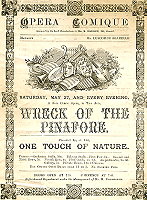 |
WRECK OF THE PINAFORE New Zealander Horace Lingard's sequel, The Wreck of the Pinafore, had been seen in the Antipodes and America before the composer, Luscombe Searelle (real name, Isaac Israel) had the gall to sail it into the Opera Comique (where the original had premiered) on May 27th 1882. The characters of Pinafore are wrecked on a desert island: Josephine and Ralph don't make a perfect match, and she switches to Sir Joseph, after Buttercup admits to lying about the switch in babyhood. Greeted with loud derision on opening night, The Wreck was soon wrecked, lasting only four performances. |
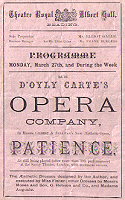 |
PATIENCE on tour The number 2 Patience company started touring the UK on Jan 2nd 1882, while the piece was still on stage at the Savoy. By March 27th the tour had reached the Royal Albert Hall in Reading, where it played for one week. Frederick Federici played the Colonel, but his name is mis-spelled in the programme. |
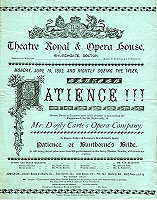 |
PATIENCE on tour Early tour programme from the Theatre Royal and Opera House in Bolton, where the number 2 Patience company played for six nights from June 19th 1882. Superb example of Victorian typography produced by the local printer. This week of performances is unrecorded in Rollins & Witts. |
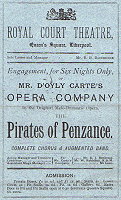 |
PIRATES / A SILENT WOMAN on tour Pirates continued to tour in the provinces years after the London production had closed. On 25th September 1882 the "No. 1 Pirates Company" was nearing the end of its existence when it played six nights at the Royal Court Theatre in Liverpool. W.T Hemsley played Samuel as well as Arthur Merton in T. H. Lacy's farce "A Silent Woman" which opened the bill. Jospephine Findlay also played two roles, Isabel and Marianne Sandford, while C.J. Stanley appeared in just the curtain raiser, as Mr. Sandford. |
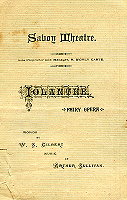 |
IOLANTHE - OPENING NIGHT Iolanthe was the first piece to have its premiere at the Savoy Theatre, opening on 25th November 1882. This opening night programme states the date inside, and also notes that "on this occasion the opera will be Conducted by the Composer". This cheap-seats version is printed on an odd ribbed paper of pale green. |
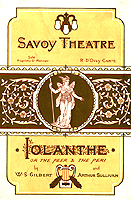 |
IOLANTHE / MOCK TURTLES This programme, issued to those in better seats, is something of a classic, famously incorprating the Savoy's electric light bulbs into the decorative scheme. It dates from between December 1882 and February 1883, as Leila is played by Julia Gwynne, and Celia by May Fortescue. Rosina Brandram appears in the curtain raiser with Eric Lewis. |
| 1883 |
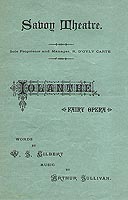 |
IOLANTHE This programme, of the type issued to those in cheaper seats, dates from between February and August 1883, during which period Leila was played by Maud Cathcart. |
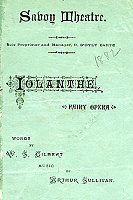 |
IOLANTHE matinee An undated programme, with full first cast, there is no clue when this may have been produced. The lack of curtain raiser suggests that it was for use at a matinee. Iolanthe ran with Mock Turtles until 30th March 1883, and then A Private Wire until the end of its run. |
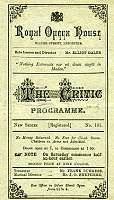 |
IOLANTHE on tour lolanthe arrived at the Royal Opera House in Leicester on May 28th 1883. Frank Thornton starred as Chancellor with Laura Clement as Phyllis. The curtain raiser was Cups and Saucers. |
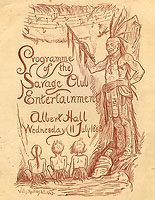 |
SAVAGE CLUB ENTERTAINMENT On Wednesday 11th July 1883 George Grossmith, John Maclean (Thespis), Lionel Brough and many others entertained members of the Savage Club during the annual Ball at the Albert Hall. The Prince and Princess of Wales were in attendance, and the programme included music by Sullivan, the recitation of a Bab Ballad, and much else of interest. |
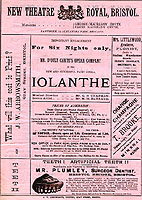 |
IOLANTHE on tour Early tour programme for Iolanthe and Cups and Saucers at the New Theatre Royal in Bristol, where it played for six nights from November 12th 1883. Frank Thornton must have been rather busy, playing Lord Chancellor and being Stage Manager ! The first provincial production had opened a little over a month after the London premiere. |
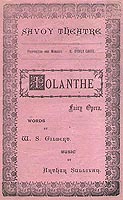 |
IOLANTHE /A PRIVATE WIRE The cast changes in Iolanthe during its long run affected mainly the minor characters. This version of the regular programme, with rather different artwork, dates from after November 1883, when Warwick Gray was playing Private Willis. Iolanthe closed on Jan 1st 1884, after a run of 398 performances. |
| 1884 |
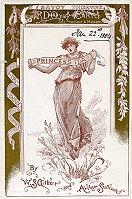 |
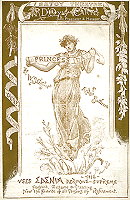
PRINCESS IDA Princess Ida opened on 5th January 1884, and closed on October 9th, after a disappointing run (for a G&S opera) of just 246 performances. This exceptional programme was produced for those in the better seats, and has no advertisements of any kind. Dated 22nd Jan 1884, it describes the opera as being "in a prologue and two acts". Despite the early date, Ada was already being played by Lilian Carr. It is decorated inside with characters from the piece and is printed in maroon and gold. |
 |
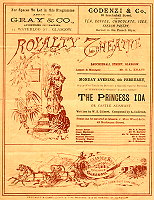
PRINCESS IDA Superficially similar to the souvenir shown above, but note that the cover has been made into an advert, so that it now reads, "Princess Ida uses Edenia, the perfume supreme" ! It also has further adverts inside, and describes the opera as having three acts. It is printed in brown and gold. |
 |
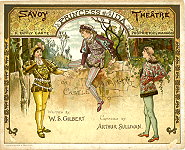
"THE
PRINCESS IDA" on tour
This opening night programme for the first provincial performance of Princes Ida, at the Royalty Theatre in Glasgow, 4th Feb 1884, adds a "The" to the title of the piece, both inside and on the cover. By this time Richard D'Oyly Carte was clearly geared up to a speedy launch in the provinces, this production opening within a month of the Savoy premiere. |
 |
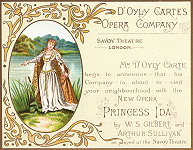
PRINCESS IDA The regular Princess Ida souvenir programme has superb artwork by Alice Havers, with four colour, and four sepia, illustrations from the opera. The back pages use the characters as frames for advertisements. This example names Lilian Carr as Ada, but otherwise has the opening cast. |
 |
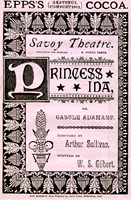
PRINCESS IDA tour herald This four page herald uses Havers' artwork, the cover being almost the same as the Savoy programme shown above although it is much smaller, just 4.5" x 3.5". It mostly consists of adverts, but page two, shown at left, was used to promote forthcoming performances by the Princess Ida company on tour. |
 |
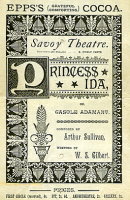
PRINCESS IDA Dated for 7th March 1884, this Princess Ida programme shows all the opening night cast in place except Lilian Carr, who replaced Miss Twyman as Ada during the first month. A contemporary pencil notation suggests that Kate Chard, who usually played Psyche, took the lead role on this occasion. |
 |
PRINCESS IDA An undated programme, this example has the same cast, but is printed on pale green paper. |
 |
PRINCESS IDA LAMPOON Princess Ida, despite not being a huge success, was clearly considered sufficiently well known by March 15th 1884, for "Funny Folks" the satirical newspaper, to feature a pastiche of the opera on the cover. In this instance Ida's brothers are played by "Parney, Randy & Staffy" (Charles Stuart Parnell, Randolph Churchill and Stafford Henry Northcote). They threaten to obstruct a shadowy Gladstone with the words: "Politics we bar / Obstruction our bent / On the whole we are / Not intelligent". |
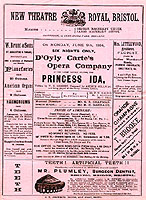 |
PRINCESS IDA on tour Early tour programme for Princess Ida at the New Theatre Royal in Bristol, where it played for six nights from June 9th 1884. Although not named in the programme, this tour marked Henry Lytton's first D'Oyly Carte appearance, in the chorus; his wife, Louie Henri played Ada. Fred Billington, who had, by default, created the role of Sergeant of Police in Paignton in 1879, plays Hildebrand, and Hilarion is played by Courtice Pounds, who would go on to create the roles of Fairfax and Marco at the Savoy. |
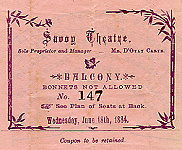 |
PRINCESS IDA TICKET Rare ticket for Balcony seat at the Savoy Theatre for the Wednesday June 18th performance of Princess Ida in 1884. The reverse has a mini seating plan of the balcony, with all seats numbered, showing that seat 147 was in the back row. |
 |
PRINCESS
IDA at Drury Lane benefit
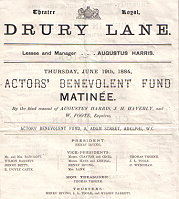
Selected as the finale of the annual Actors Benevolent Fund Matinee, at Drury Lane on June 19th 1884, was a selection from Princess Ida, featuring Durward Lely, Charles Ryley and Henry Bracy. Also on the bill that afternoon were, among many others, Henry Irving, Ellen Terry, and Kate Vaughan. Madame Patey and Mr Santley also sang, and it is maybe not entirely coincidental that Richard D'Oyly Carte is named on the cover as Vice-President of the charity ! |
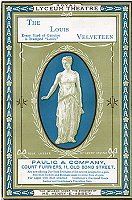 |
COMEDY & TRAGEDY / PYGMALION & GALATEA Gilbert's 1871 play Pygmalion & Galatea was revived at the Royal Lyceum Theatre on December 8th 1883, with Mary Anderson making her British debut as Galatea. On January 26th 1884 a new Gilbert afterpiece, Comedy & Tragedy, was added to the bill. Following a successful Anderson toured the British Isles, before returning again to the Lyceum. She appears on the cover of this lavish souvenir programme, dressed as the statue Galatea. It is dated September 6th 1884, probably the first night of the second part of the Lyceum run. |
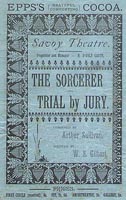 |
SORCERER / TRIAL REVIVAL OPENING NIGHT D'Oyly Carte had no original opera to put into the Savoy following the relative failure of Princess Ida. The Sorcerer was therefore given a new act 2 opening, and paired with "Trial" for the opening night of the first DOC revival on October 11th 1884. As stated in this programme, Sullivan conducted the first performance. |
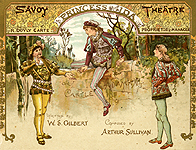 |
SORCERER / TRIAL REVIVAL D'Oyly Carte continued to use old artwork on his full-colour programmes for some time after each new opera opened. This Princess Ida cover was used for the first revivals even a month after they opened. |
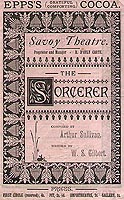 |
SORCERER / TRIAL Programme for the first revival of The Sorcerer and Trial By Jury, which ran together for 150 performances, until March 12th 1885. Durward Lely left the cast of Trial in mid-November, so this example must have been printed earlier. |
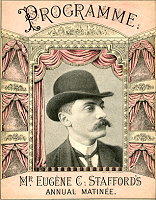 |
THE WEDDING MARCH Gilbert's play, The Wedding March had premiered in 1873, so was perhaps a strange choice for Eugene C. Stafford's Annual Matinee at the Gaiety Theatre on 4th December 1884, with a cast headed by Lionel Brough and Lydia Thompson. The programme is exceptional, with a portrait of Stafford on the cover, surrounded by a view of the Gaiety proscenium arch, while inside is a view from the stage, with seats and boxes numbered. It seems likely that the chap was employed at the venue, possibly in the box office. |
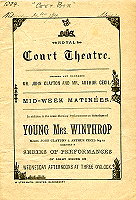 |
COX & BOX Presented at the Royal Court Theatre, with Richard Temple, Arthur Cecil and Furneaux Cook, as part of a series of Wednesday afternoon matinees. This programme was produced for the 10th Dec 1884 performance, when the Sullivan piece was joined on the bill by My Milliner's Bill and Twenty Minutes Under an Umbrella. |
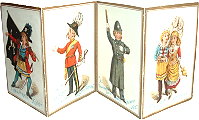 |
CHILDREN'S PIRATES OF PENZANCE From Dec 26th 1884 until Feb 14th 1885, a company of children performed a series of matinees of The Pirates of Penzance at the Savoy. This four-sided foldout souvenir programme depicting the child actors on one side and full details of cast etc on the back was among the most elaborate and expensive ever produced by D'Oyly Carte. |
| 1885 |
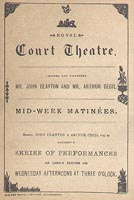 |
COX & BOX Although undated, this programme was produced for the 7th Jan 1885 performance of Cox and Box with Temple, Cecil and Cook. It includes details of the 14th Jan entertainments which included Weedon Grossmith removing brother George's tooth ! |
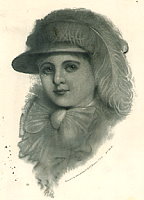 |
COX
& BOX
Programme, with decorative cover, for a "special dramatic performance" on Jan 22nd 1885, by the Vaudeville Club, of Daisy Farm followed by Cox & Box. St George's Hall, Langham Place, was the venue, and Bouncer was played by S. Ambrose. The title roles were taken by W.J. Strip and J. Stephens. |
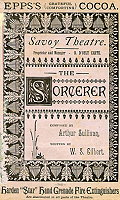 |
SORCERER / TRIAL REVIVAL There was only one cast change during the short (150 performance) run of Sorcerer/Trial, and this programme dates from February or March 1885, when Jessie Bond was replaced as Constance by Alice Davies. An indulgence slip, pasted into the programme, shows that Lyn Cadwaladr played Alexis, due to the indisposition of Durward Lely. The run ended on March 12th 1885. |
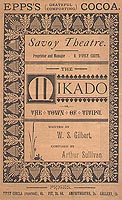 |
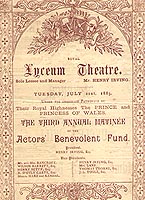
THE MIKADO The Mikado opened at the Savoy on March 14th 1885 and didn't close until Jan 19th 1887. This programme has all the original cast members in place, and must date from the first few weeks of the run, as it doesn't include the character Go-To, added in April 1885. |
 |
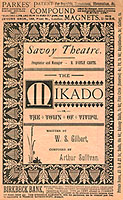
PATIENCE BENEFIT Although The Mikado was still running, the D'Oyly Carte stars Grossmith, Barrington, Braham & Brandram chose to present a scene from Patience at the Lyceum Theatre at 3pm on July 21st 1885 as part of a benefit performance for the Actors' Benevolent Fund. The conductor of the segment was F. Cellier. Mr. J.L. Toole (of Thespis) also appeared, as did Sarah Bernhardt, Henry Irving and Ellen Terry. |
 |
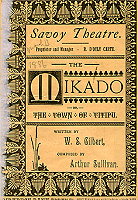
THE MIKADO From rather later in the run, this programme does include Go-To, played by Rudolph Lewis. I've always had a soft spot for the role, as it was my first, in a school production. Eight words and nine whole syllables - what a star ! This example is in better condition than most. |
| 1886 |
 |
THE
MIKADO
Dated by hand for 13th March 1886, this programme is perhaps most interesting for the indulgence slip was has been pasted inside, showing that Jessie Bond was indisposed, and that her part was taken by Annie Cole. Although Cole is known to have played Pitti-Sing from Sept to Nov 1886 this may have been the first occasion she stepped out from the chorus to play a major part. |
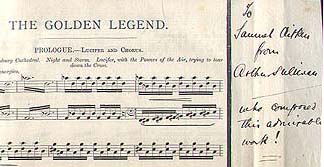 |
GOLDEN LEGEND SIGNED PROOF SCORE Signed by Arthur Sullivan, and containing amendments to the stage directions in the hand of the lyricist Joseph Bennett, this bound set of proof pages dates from 1886. Although sold in February 2004, full details remain on the site, for the use of scholars and researchers. |
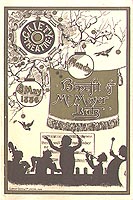 |
MEYER LUTZ BENEFIT On Monday 3rd May 1886 the Gaiety Theatre was host to a selection of scenes played for the benefit of composer Meyer Lutz. These included scenes from the Grand Opera Mephistopheles, the musical Little Jack Shepherd and the operetta Karl as well as recitations and solo pieces. Many names associated with Gilbert and Sullivan were among the performers, including Ellen Farren (Thespis), and Marion Hood (first London Mabel). The men included Durward Lely and Richard Temple. |
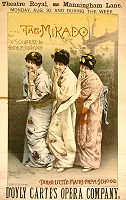 |
MIKADO POSTER The Mikado D-company tour reaching Bradford on Aug 30th 1886 where this large poster was overprinted with details of the week-long stay at the Theatre Royal. Strangely, the design appears to be based on an image of the first American little maids, featuring, from left to right, Geraldine St Maur, Geraldine Ulmar and Kate Forster. |
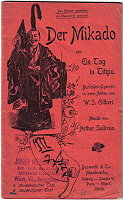 |
DER MIKADO In September 1886 a German-language version, Der Mikado oder Ein Tag in Titipu, opened in Vienna. This libretto has cover art featuring the title character and was probably produded not long after the Austrian premiere. It is the South German version of the text, and an interesting note at the top of the cover translates to something like, "Printed as a manuscript for the stage/theatres ", possibly indicating that it was originally owned by a cast member and used in rehearsal. |
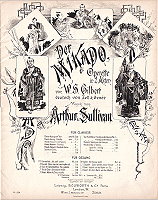 |
DER MIKADO Mikado characters adorn this German sheet music which almost certainly dates from c.1886 and uses the same image of the title character, and surrounding decoration, as the cover of the early German libretto above. |
| 1887 |
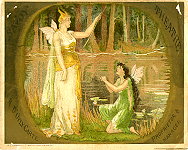 |
RUDDYGORE - OPENING NIGHT Ruddygore opened at the Savoy on January 22nd 1887. This opening night programme states the date inside, and also notes that "on this occasion the opera will be conducted by the composer". The souvenir has scenes from Iolanthe and Patience on the covers, and Pirates and The Sorcerer inside. |
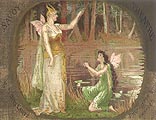 |
RUDDIGORE / THE CARP On, or around, 2nd February 1887, the spelling of the opera's title was changed, for reasons of decency. By the time this souvenir programme was printed, on 6th April, Josephine Findlay was playing Rose Maybud for a short period. All the other original major cast members were in place. |
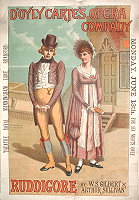 |
RUDDIGORE POSTER Ruddigore first appeared in the provinces at Newcastle on March 7th 1887, the C-Company tour reaching Bradford on June 13th where this large poster was overprinted with details of the week-long stay at the Theatre Royal. Rather naively executed, it shows Robin and Rose in front of the first act set. |
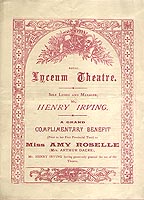 |
TRIAL BY JURY Another Lyceum benefit, this one for Amy Roselle on 16th June 1887. George Grossmith performed a "sketch", and Irving and Terry appeared in a scene from The Merchant of Venice. The afternoon concluded with Trial by Jury; lead roles taken by Rutland Barrington, Richard Temple, Rudolph Lewis, Geraldine Ulmar and Henry Bracy. Leading theatrical personalities of the day appeared in Court. |
 |
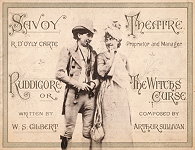
RUDDIGORE / THE CARP This "cheap-seats" programme names Geraldine Ulmar as Rose Maybud. She had replaced Leonora Braham in May 1886. There are clearly some errors in Rollins & Witts concerning Ruddigore casts, as this programme also has Brandram as Dame Hannah, Aida Jenoure as Zorah, and Mr. Shirley as Sir Desmond. Interestingly, these cheap programmes include the names of the actors playing the Act Two ghosts, which do not appear in the more lavish souvenirs. |
 |
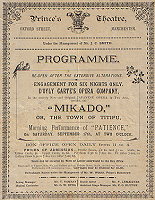
RUDDIGORE / THE CARP Quite late in the Ruddigore run the souvenir programme was changed to include scenes from the actual opera being performed. This programme, dated 1st Nov, has Geraldine Ulmar playing Rose and Aida Jenoure as Zorah. It would also appear that Rosina Brandram returned to her role of Dame Hannah before the opera closed, four days later, on November 5th 1887, after 288 performances. A rather less impressive run than The Mikado ! |
 |
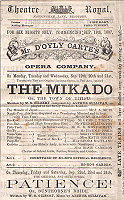
THE MIKADO on tour The Mikado toured the provinces with Patience in the latter part of 1887. This copy of the the programme of the first engagement of D-Company following a tour of Europe was originally owned by Ivy Bonheur (Yum-Yum), and she has written at the top "my first appearance professionally in Comic Opera". Bonheur's real name was Eveline Medora Gunning, and she was half sister of Frank Wyatt, who would go on to create the role of the Duke of Plaza Toro. The Mikado was performed at the Prince's Theatre in Manchester for three nights in the week of 12th September. |
 |
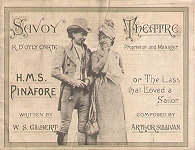
THE MIKADO & PATIENCE on tour Barely three months after seeing Ruddigore (see poster above) Bradford audiences received D-Company, performing The Mikado and Patience. Each opera was given three times at the Theatre Royal in the week of September 19th 1887, and the programme did duty for both pieces. George Thorne was Ko-Ko with Fred Billington as Poo-Bah (sic). The only surprise in the casting was Mr Jones as Bunthorne's Solicitor, not Mr Cottrell as suggested by Rollins & Witts. As was often the case in the provinces the title of Patience was given an illegal apostrophe ! |
 |
PINAFORE - FIRST REVIVAL On November 12th 1887, following the early close of Ruddigore, Richard D'Oyly Carte was forced, once again, to mount a revival at the Savoy. Pinafore was given a run of 120 performances, closing on 10th March 1888. This example of the souvenir programme is dated 13th December 1887. |
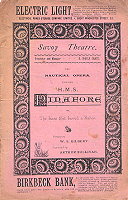 |
PINAFORE - FIRST REVIVAL Cheap-seats version of the programme for the first revival of Pinafore. During the run there were cast changes affecting the roles of Josephine and Hebe, but here Geraldine Ulmar and Jessie Bond, who had appeared on the opening night in 1887, are still in place. After the performance George Grossmith gave his drawing room sketch, "Homburg; or Haunted By the Mikado", as an afterpiece. |
| 1888 |
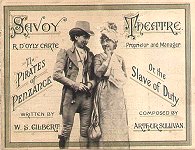 |
PIRATES - FIRST REVIVAL The Pirates of Penzance was given its first revival on March 17th 1888. It closed on 6th June, after just 80 performances - one of the shortest runs in the nineteenth century for a G&S opera. This example of the souvenir programme is dated 26th March 1888. The forepiece was Mrs. Jarramie's Genie. |
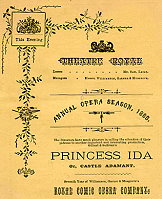 |
PRINCESS IDA in SYDNEY Leonora Braham, who had created the title role in Princess Ida at the Savoy, was also the first to play the part in Sydney, in April 1888. Her husband, J. Duncan Young, played "Hilarlon" according to the programme, and the cast also included Alice Barnett, the first Queen of the Fairies, as Lady Blanche. |
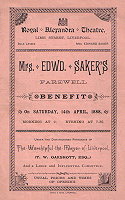 |
PYGMALION & GALATEA - Liverpool benefit On Saturday 14th April 1888 the Royal Alexandra Theatre in Liverpool hosted a pair of farewell benefits for the wife of the lessee, Mrs Edward Saker. In the evening Gilbert's Pygmalion & Galatea was produced, "under the direction and personal superintendence of the author". Assuming that Gilbert was in Liverpool for the actual event he was almost certainly cajoled into being one of the "literary, dramatic and local celebrities" who formed the jury for the Bardell v Pickwick trial scene which formed part of the matinee performance. |
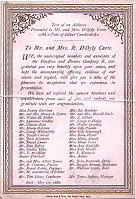 |
CARTE WEDDING: gift from E-Company On 1st May 1888 E-Company was appearing in Bath and a local printer was comissioned to print this souvenir card for the cast members to keep. It records the text of an address presented, with a pair of silver candlesticks, to the Richard D'Oyly Carte and Helen Lenoir, who had wed on April 12th. It is a fascinating record of the names of the company and its associates, including many choristers whose names have previously been unrecorded. |
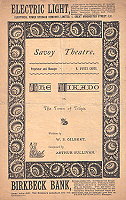 |
THE MIKADO - FIRST REVIVAL During the 116 performance run of the first Mikado revival there were a number of cast changes. This programme has Richard Temple in the title role, Geraldine Ulmar as Yum-Yum, Annie Cole as Pitti-Sing and Brandram, Grossmith and Barrington recreating their original parts. The curtain raiser was Mrs Jarramie's Genie. The revival opened at the Savoy on June 7th 1888 and ran until September 29th. |
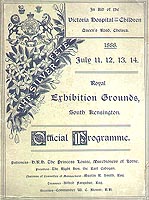 |
COX & BOX etc. Richard Temple, Bernard Lane and Furneaux Cook played Cox, Box and Bouncer in a performance of Cox and Box on July 12th 1888; part of "The Silver Fete", a four-day charity event held at the Royal Exhibition Grounds in South Kensington in aid of the Victoria Hospital for Children in Chelsea. Other D'Oyly Carte regulars named in this thick brochure include Grossmith, Pounds and Brandram. (Interestingly, Gilbert is given author credit for Cox & Box !) |
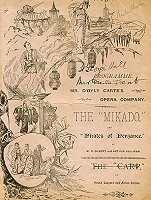 |
MIKADO & PIRATES on tour Despite an extraordinarily decorative cover, this programme has no printed details of venue or date. The original owner's scribble on the front, "St George's Hall, Burton on Trent, Oct 1888" is backed up by Rollins & Witts, as the cast is almost what might have been expected on October 3rd and 4th, when "C" Company appeared in the town for just two nights. Although "The Carp" was to have been presented with Pirates the title has been crossed through, both on the cover and inside. |
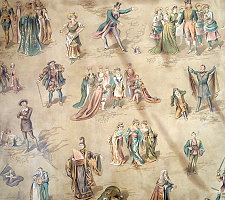 |
1880's WALLPAPER A short section of Gilbert & Sullivan wallpaper, featuring characters from Sorcerer to Ruddigore only, and therefore confidently dated to 1887 or 1888. The operas are titled in a typeface typical of this period, and some of the motifs have been lifted from early theatre programmes. The first revivals of Pinafore, Pirates and The Mikado in 1887/8 possibly meant that for the first time the G&S operas were now considered as a body of work, with a cast of many and varied characters. This process fed into the production of souvenirs showing characters from a mixture of pieces - this paper being an especially early example. |
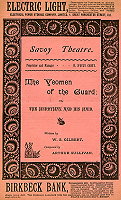 |
THE YEOMEN OF THE GUARD The Yeomen of the Guard opened at the Savoy on December 7th 1888. This first cast programme is in poor condition, but does name Tom Redmond as 1st Citizen, a role he apparently only played during 1888. The forepiece was Mrs. Jarramie's Genie. |
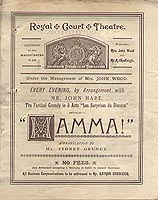 |
COX & BOX / MAMMA ! Arthur Cecil, Eric Lewis and William Lugg played box, Cox and Bouncer when Burnand and Sullivan's Cox & Box was performed at the Royal Court Theatre in London as a forepiece to the play Mamma !. It was first seen at this revival on 25th October 1888. |
| 1889 |
 |
YEOMEN
/ MRS. JARRAMIE'S GENIE
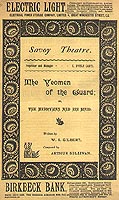
Discreetly dated in pencil, this near-mint programme for The Yeomen of the Guard was most likely acquired at the Savoy on January 26th 1889. The opera had opened on December 7th 1888, and ran for 423 performances, closing on November 30th 1889. |
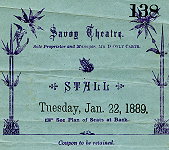 |
YEOMEN TICKET Rare ticket for Stall seat at the Savoy Theatre for the Tuesday Jan 22nd performance of The Yeomen of the Guard in 1889. The reverse has a mini seating plan of the stalls, with all seats numbered, showing that seat 138 was in the eighth row. |
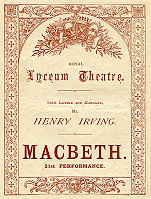 |
MACBETH Henry Irving first appeared with Ellen Terry in the Lyceum production of Macbeth on December 29th 1888. Details of the music which Sullivan composed specifically for this production which are given inside this Feb 2nd 1889 programme for the 31st performance of the play. |
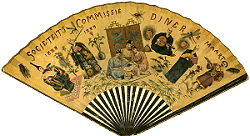 |
1889 MIKADO FAN Souvenir of a club dinner in Holland in March 1889 showing members of the committee in Mikado costumes appropriate to their roles in the society. Two of the Three Little Maids are moustachioed ! |
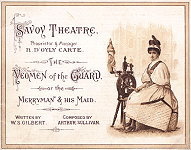 |
YEOMEN souvenir Dated 29th March 1889, this style of souvenir, with Jessie Bond as Phoebe on the cover, was used in the middle of the run. Interestingly, Tom Redmond is named as 1st Citizen despite the late period. |
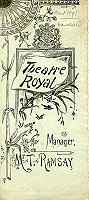 |
YEOMEN
on tour
The Yeomen of the Guard at the Prince's Theatre in Manchester, July 1st 1889. The city had hosted the first provincial production of the piece, almost exactly a year earlier. |
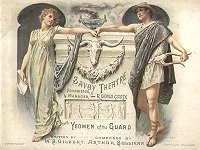 |
YEOMEN
SOUVENIR
Produced for those sitting in the better seats at the Savoy, the souvenir booklet includes coloured illustrations of scenes from The Yeomen of the Guard. It dates from September 2nd 1889, soon after John Wilkinson had replaced Grossmith as Point, and was printed in an edition of five hundred copies. This style of souvenir became the standard at the Savoy for the following five years or so. |
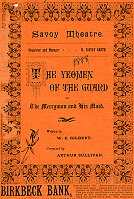 |
YEOMEN
/ MRS. JARRAMIE'S GENIE
A late programme for Yeomen, dated 23rd Sept 1889, printed on bright orange paper. Grossmith had been replaced as Jack Point by John Wilkinson in August 1889, and Mr Lees had taken the role of First Citizen at around the same time. Geraldine Ulmar's name has been crossed out by the original owner, and "Norah Phyllis" written in. If this were the fact it would have marked Norah's Savoy debut (she created the role of Giulia later in December 1889, and would cover for Ulmar again during the same month). |
| 1890 |
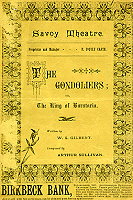 |
THE
GONDOLIERS
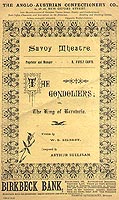
From an edition of one thousand, printed on 20th March 1890, and apparently issued two days later, this programme shows that the majority of the cast who had opened the piece on December 7th 1889 were still playing their original parts. The exceptions are among the female characters, as here we have Annie Cole as Tessa, Jose Shalders as Vittoria, and Cissie Saumarez as Giulia. |
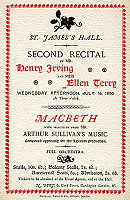 |
MACBETH RECITAL On Wednesday afternoon, July 16th 1890, at St James's Hall, Henry Irving and Ellen Terry gave a recital of scenes from their production of Macbeth, first seen at the Lyceum in 1888. Sullivan had composed music specifically for this production, and at the 1890 recital a full orchestra played the pieces. This rare flyer for the event is printed on hand made paper. |
 |
THE
GONDOLIERS
D'Oyly Carte had major problems with his Gianettas during the run of The Gondoliers. The part, created by Geraldine Ulmar, was played by a total of fifteen actresses during the 554 performance run (though interestingly these are not the same 15 sopranos listed in Rollins and Witts !). Here Gianetta is Esther Palliser. |
| 1891 |
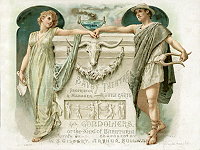 |
GONDOLIERS
SOUVENIR
On 5th Jan 1891 Nita Carritte took over the role of Gianetta, giving around 54 performances, until 27th February. This souvenir, printed on 9th Feb, has a number of other variant cast members: W.S. Laidlaw, Giuseppe; W.R. Shirley, Francesco; P. Burbank, Annibale; Rudolph Lewis, Ottavio; and Cissie Saumarez as Giulia. |
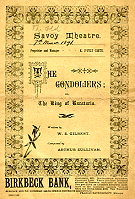 |
THE
GONDOLIERS
By March 1891 Gianetta was being played by Carrie Donald and Giulia was Cissie Saumarez. Although the programme was issued on 7th March it had been printed four days earlier. The production closed on June 20th 1891 after 554 performances. |
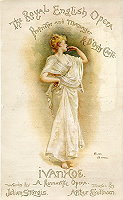 |
IVANHOE - OPENING NIGHT The opening production at the Royal English Opera, D'Oyly Carte's new theatre, was Ivanhoe, an opera by Sullivan. The souvenir programme for the opera is known to exist with at least two different covers, although neither appears to represent characters from the piece, which opened on Jan 31st 1891. D'Oyly Carte regulars Charles Kenningham, Frederick Bovill, Esther Palliser and Richard Green are named in this opening night copy, which is dated in full, but which does not state that Sullivan would conduct. |
 |
IVANHOE:
100th performance
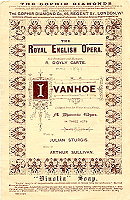
Sullivan conducted the 100th performance himself. Although some were given an illustrated souvenir to mark the occasion, those in cheaper parts of the house got a paper programme, including a note that "On this occasion the Opera will be Conducted by the COMPOSER." Dated in code for 25th May 1891, the programme also contains a slip, noting that the title role would be played by Mr J. O'Mara on this occasion. |
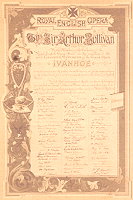 |
IVANHOE: 100th performance A trimmed cabinet card photo of a presentation certificate given to Sullivan by the members of the Royal English Opera orchestra on the occasion of the 100th performance of Ivanhoe. As well as signatures of conductors and players there is a decorative border which incorporates the music of one of the Torquilstone trumpet calls as well as the shields of The Templar and Ivanhoe. |
 |
GONDOLIERS
BY ROYAL COMMAND
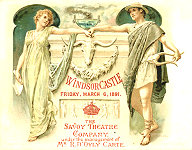
This souvenir was produced for one of the most important events in D'Oyly Carte history, when The Gondoliers was presented in front of Queen Victoria at Windsor Castle on March 6th 1891. Very few can have been printed, and even fewer survive. Contrary to legend, the programme does name Gilbert as the author. |
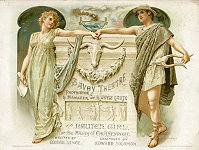 |
THE NAUTCH GIRL The first non-G&S piece presented at the Savoy, The Nautch Girl opened on June 30th 1891. Written by George Dance, with music by Edward Solomon, the opera starred many familiar names: Rutland Barrington, Courtice Pounds, Franks Thornton, Jessie Bond, Frank Wyatt, W. H. Denny etc. |
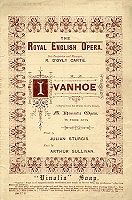 |
IVANHOE With an amazing continuous run (for grand opera) of 155 performances, achieved through the use of two alternating casts, Ivanhoe closed on July 31st. This copy, dated 27th July 1891 names the Welsh tenor Ben Davies as Ivanhoe, with Ffrangcon Davies as Cedric, and most of the other opening night cast members. |
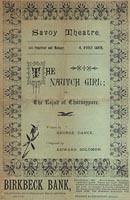 |
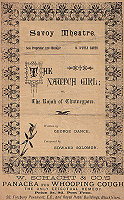
THE
NAUTCH GIRL
This example of the The Nautch Girl programme probably dates from after the start of a series of major cast changes which occured in Autumn 1891. Miss Shalders plays Banyan, and there is no curtain-raiser, which would indicate a date between August and September, but neither Rutland Barrington not Jessie Bond are named, which according to Rollins and Witts, they should be at this time ! |
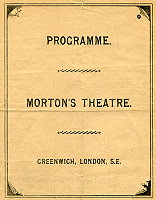 |
MIKADO
& IOLANTHE
D'Oyly Carte on tour at Morton's Theatre in Greenwich, SE London, with Henry Lytton as Ko-Ko and Chancellor, October 19th and 20th, 1891. A note in the programme states that the following week the Monday performance would be under the patronage and in the presence of W.F. Cody (Buffalo Bill), but by this time Lytton et al would be in Croydon ! |
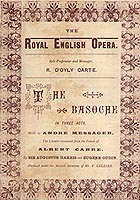 |
THE
BASOCHE
Richard D'Oyly Carte's second venture at his new opera house was La Basoche by Andre Messager. It opened on November 3rd 1891, and ran until Jan 16th of the following year, with a few Savoy regulars in the cast. Disillusioned by the project, Carte sold the theatre, which became the Palace Musical Hall, and later the Palace Theatre. This programme is dated for the 14th November 1891. |
| 1892 |
 |
THE
NAUTCH GIRL / CAPTAIN
BILLY
This example of a Nautch Girl programme is dated 8th January 1892 and would indicate that, contrary to Rollins and Witts, Rutland Barrington and Jessie Bond returned to play The Rajah and Chinna Loofa for the final few performances. Edith Briant (or Bryant ?) also made an unexpected appearance as Cheetah at this time. The piece closed on Jan 16th 1892, after 200 performances. In the curtain-raiser, Captain Billy, which had opened on 23rd September 1891, Cissey (sic) Saumarez played Polly. |
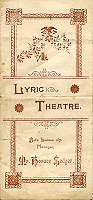 |
THE MOUNTEBANKS Gilbert's opera The Mountebanks opened at the Lyric Theatre on 4th January 1892, and ran until August. The composer, Alfred Cellier, died eight days before opening night, and his work was completed by Ivan Caryll. The cast included the latter's wife, Geraldine Ulmar, the original Gianetta, and Frank Wyatt. |
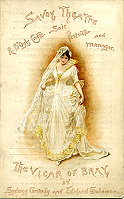 |
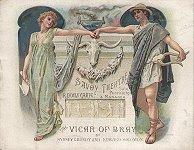
VICAR
OF BRAY - OPENING NIGHT
Second of D'Oyly Carte's stop-gap productions, The Vicar of Bray opened on 28th January 1892. This souvenir programme for the opening night clearly states that on this occasion the opera would be conducted by the composer, Edward Solomon. The cast included many DOC regulars: Barrington, Pounds, Brandram etc. |
 |
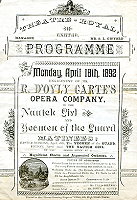
VICAR
OF BRAY / CAPTAIN BILLY SOUVENIR
The Vicar of Bray was a revised version of Sydney Grundy's comic opera which had originally been produced at the Globe Theatre in 1882. The Savoy piece closed on June 18th after 142 performances. This souvenir programme is dated for 9th April 1892. |
 |
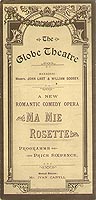
NAUTCH GIRL & YEOMEN on tour On April 18th 1892 "B" Company reached Exeter, presenting The Nautch Girl and The Yeomen of the Guard. The programme covered both pieces. |
 |
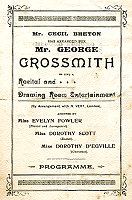
MA MIE ROSETTE Jessie Bond was one of the longest serving regulars in the D'Oyly Carte Company, appearing in most original productions from Pinafore onwards. She had a break from the Company in the 90's, playing in a series of other musicals in London. Ma Mie Rosette opened in 1892 at the Globe Theatre. |
 |
GEORGE GROSSMITH PROGRAMME Grossmith too, having created role from J.W. Wells to Jack Point, took a break from the Savoy in the '90s, touring Britain as a comic entertainer. Although undated, this programme includes a duet from Haste to the Wedding, the Gilbert flop (with music by Grossmith) which had folded in just 22 performances at the Criterion in the Summer of 1892. |
 |
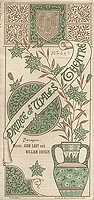
THE MOUNTEBANKS on tour On Sept 12th 1892 Gilbert's The Mountebanks arrived in Bristol, at the Prince's Theatre. Horace Sedger's Company presented the piece, and the programme includes a summary of the plot. |
 |
MA MIE ROSETTE In December 1892 Ivan Caryll's comedy opera (based on a French piece by Paul Lacome) was moved to The Prince of Wales Theatre, where it finished a fairly short run. The entire cast moved across with the production, including as well as Bond, Savoyards Courtice Pounds and Frank Wyatt. |
| 1893 |
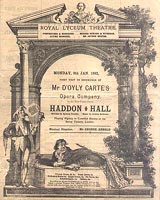 |
HADDON HALL While still running in London, a touring production of Haddon Hall was sent on the road, reaching Edinburgh on 9th Jan 1893. This was the first visit of a D'Oyly Carte company to this Scottish city. |
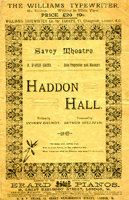 |
HADDON HALL Following the last night of The Vicar of Bray, the Savoy was dark for over three months, finally opening on 23rd Sept 1892 with a new Sullivan opera, Haddon Hall. Sir Arthur's collaboration with Sydney Grundy proved unpopular, and the piece ran for just 204 performances. This unusual programme, dated 21st January 1893, has Bates Maddison as John Manners, a role he played for a very short period, and unrecorded by either Rollins & Witts or Ganzl. |
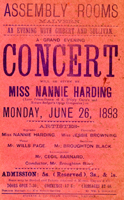 |
AN EVENING WITH GILBERT & SULLIVAN An early example of a G&S themed entertainment, at the Assembly Rooms in Malvern, June 1893. This fragile flyer describes Nannie Harding (aka Annie Harding) as "late prima donna of R. Doyly Carte's Company". She had actually only appeared as Lady Ella in Europe and as Kate and Casilda in the "C" company tour ! Broughton Black had also toured in company "C" in the early 90s. Jessie Browning would later tour for DOC, but at this point in time had not yet appeared with the company. Wills Page never would. |
 |
JANE
ANNIE / MR. JERICHO
One of the most interesting of the non-G&S operas produced by D'Oyly Carte in the 1890s, Jane Annie was written by J.M. Barrie and Arthur Conan Doyle, with music by Sullivan's pupil, Ernest Ford. Despite this excellent pedigree, and a cast of DOC regulars, the piece was the first real Savoy flop, opening on May 13th 1893 and closing after just 50 performances. This programme was printed on 30th June, and according to the pencil annotation on the cover, was issued at the last performance on 1st July. The Savoy remained dark throughout July, August and September. |
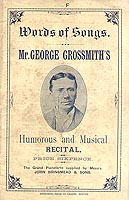 |
GEORGE GROSSMITH on tour From August 28th to December 19th 1893, George Grossmith criss-crossed Britain, usually appearing for one-night-only in each town. This fascinating 24-page booklet not only gives all the tour dates, but has words to all the songs he performed, including "The Paderewski Craze" and "The Dismal Dinner Party". At the back are three pages of press quotes from his American tour. As this brochure is for "programme F", it seems likely that there are at least five others in the series ! |
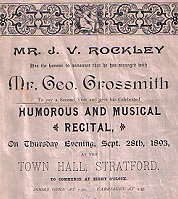 |
GEORGE GROSSMITH on tour On September 28th 1893 Grossmith's tour of the UK reached Stratford (East London) for the second time. The recital performed in the Town Hall that Thursday evening included the new sketches, "The Art of Entertaining" and "How I Discovered America". The programme also lists the songs which Grossmith gave as part of the entertainment. |
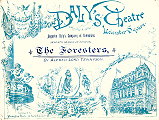 |
THE FORESTERS - OPENING NIGHT Alfred Lord Tennyson's play based on the legend of Robin Hood, The Foresters, opened at Daly's Theatre on October 3rd 1893, and included nine songs by Sullivan. This opening night programme does not suggest that he conducted, presumably as he was busy with Utopia preparations. The play ran for just 15 performances. |
 |
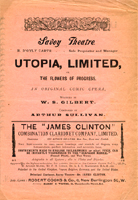
UTOPIA, LIMITED Utopia Limited opened at the Savoy on 7th October 1893, running for 245 performances. This souvenir programme, issued to those in the better seats, names all the original cast members, and is dated for Oct 23rd, by hand. |
 |
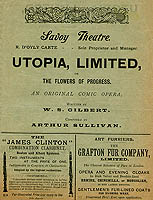
UTOPIA, LIMITED This programme is from 24th October 1893, and therefore includes all the original cast. Miss Howell-Hersee was originally employed simply to understudy Florence Easton in the tiny part of Phylla, but due to illness, she created the role. Miss Easton replaced her in November, after this programme was printed. |
 |
UTOPIA, LIMITED This green programme was printed later in the run, after Clarence Hunt had replaced Walter Passmore as Tarara. |
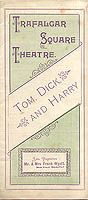 |
PICKWICK / TOM, DICK & HARRY One of the harder Jessie Bond programmes to find, Pickwick was forepiece to Tom, Dick & Harry at the Trafalgar Square Theatre, and ran for around 25 performances from 13th December 1893 to 6th January 1894. The one-act operetta by F.C. Burnand and Edward Solomon had originally been produced in 1889 at a benefit matinee, when it had featured Rutland Barrington in the part subsequently taken by Charles Hawtrey. In a further connection with G&S, the theatre was owned by Frank Wyatt, who had created the role of The Duke of Plaza Toro ! |
| 1894 |
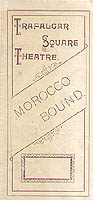 |
MOROCCO BOUND Jessie Bond was not the only former D'Oyly Carte performer engaging in extra-curricular performances at this time. Richard Temple played Sid Fakah in Morocco Bound, which moved into the Trafalgar Square Theatre on 8th January 1894, replacing Tom, Dick & Harry. The Branscombe/Ross/Carr musical completed its run on 10th February, having chalked up 295 performances in two theatres. Also in the cast were George Grossmith Jun. and the Captain Corcoran from the 1879/80 Children's Pinafore, Harry Grattan. |
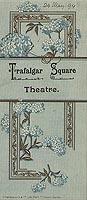 |
GO-BANG A musical comedy by Adrian Ross and Osmond Carr, Go-Bang was a rather better proposition for Jessie Bond than the run of flops in which she had been cast, though a run of 159 performances from the 10th March 1894 opening was nothing compared with her days at the Savoy. She shared the stage at the Trafalgar Square Theatre with Harry Grattan, Arthur Playfair, George Grossmith (Jnr) and dancer Letty Lind. The American child prodigy "Baby Costello" danced in the interval between acts. |
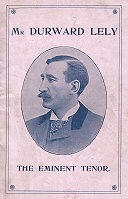 |
DURWARD LELY - THE EMINENT TENOR For three weeks from March 24th 1894 the Blairgowrie Advertiser printed details of the career of the "local-boy-made-good", Durward Lely. Subsequently reprinted in a small booklet, the text was almost certainly written by Lely himself, his work is described in such glowing terms. Although his time at the Savoy is covered in just a few pages, he does give us an interesting insight into Gilbert's working method: checking that words were clear even from the cheaper seats, and insisting on correct deportment. |
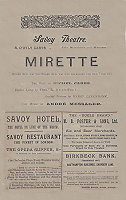 |
MIRETTE Probably the most troubled piece to appear at the Savoy, Mirette, based on a French opera by Andre Messager, opened on July 3rd 1894. After 41 performances it was taken off, and then re-opened in a revised version on October 6th. After a total run of 102 performances it finally closed on 6th December. This programme for the first version is dated 24th July, at which time the title role was played by the original, Maud Ellicott. |
 |
HIS EXCELLENCY - OPENING NIGHT His Excellency, by W.S. Gilbert and F. Osmond Carr, opened at the Lyric Theatre on 27th October 1894, running for just 161 performances. This first night programme, issued to those in better seats, has no advertisements inside. |
 |
HIS EXCELLENCY This "cheap-seats" programme was issued on Boxing Day in 1894, and still features all the original cast members, including Rutland Barrington, George Grossmith, Jessie Bond, Alice Barnett and Nancy McIntosh. |
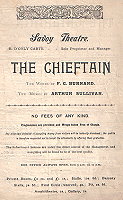 |
THE CHIEFTAIN / QUITE AN ADVENTURE The Chieftain was a reworking of Sullivan and Burnand's The Contrabandista, and opened at the Savoy on 12th December 1894, running for just 97 performances. From 15th to 29th December the Sullivan piece was preceded by a short Desprez/Solomon operetta, Quite An Adventure, in which Beatrice Perry, named in this programme, appeared for just the final week. According to the cast list Powis Pinder unaccountably played both Ferdinand de Roxas and Escatero in the main piece ! |
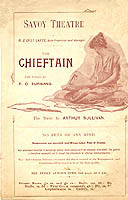 |
THE CHIEFTAN / COX & BOX Cox and Box replaced Quite An Adventure as companion piece to The Chieftain on 31st December 1894. This programme features all the original Chieftain cast members except for W. A. Peterkin who had by this time taken over the role of Ferdinand de Roxas from Scott Fische. Richard Temple played Bouncer. The Chieftain closed on March 16th 1895. |
| 1895 |
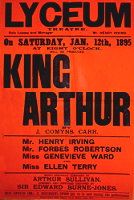 |
KING ARTHUR For King Arthur, Irving produced some of the striking posters typically used for Lyceum productions. Interestingly, this large pre-opening example is the only one I've yet seen which mentions Sullivan's name. Perhaps once the play opened there was less need to publicise the composer ? The artist Edward Byrne-Jones is also given full credit at this early stage. |
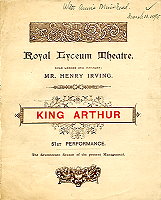 |
KING ARTHUR King Arthur,a play by J. Comyns Carr opened at the Royal Lyceum Theatre on 12th January 1895. Starring, of course, Henry Irving and Ellen Terry, the piece had choral and incidental music by Sullivan. As noted in the programme, which includes all the song lyrics, the entr'actes were also selected from Sir Arthur's previous compositions. |
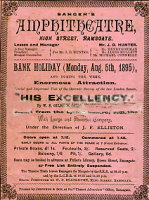 |
HIS EXCELLENCY on tour Sanger's Amphitheatre in Ramsgate was host to His Excellency for a week from August 5th 1895. Although "from the Lyric Theatre", this production by J. F. Elliston did not have the stellar cast seen in London; the lead roles were taken by Stratton Mills, Arthur Lawrence, Rose Hamilton and Madge Avery. |
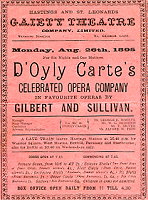 |
PATIENCE on tour For the first part of the week of Aug 26th 1895, the Hastings and St. Leonard's Gaiety Theatre was host to the D'Oyly Carte "E" company giving Patience. Emmie Owen played the title role. An announcement in the programme states that from Thursday audiences could see The Gondoliers. |
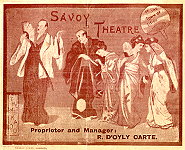 |
MIKADO
/ AFTER ALL
The second revival of The Mikado, which opened at the Savoy on 6th Nov 1895. The production featured Rutland Barrington, Jessie Bond and Rosina Brandram in their original characters, and closed after 127 performances, on March 4th 1896. This programme is dated for 6th December. |
| 1896 |
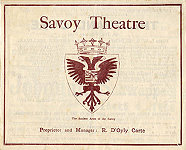 |
THE
GRAND DUKE
The Grand Duke, Gilbert & Sullivan's final collaboration, opened on March 7th 1896. Different grades of programme were produced, this one, intended for the cheaper seats, has the Savoy crest and border printed in red. It was printed on 27th March 1896. |
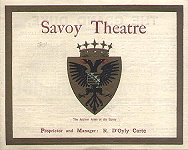 |
GRAND
DUKE / AFTER ALL
The Grand Duke ran for just 123 performances, joined by the curtain raiser After All on 4th April, and closing on July 10th 1896. This programme, intended for the more expensive seats, has details printed in gold. |
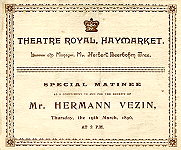 |
HERMANN VEZIN MATINEE Benefit programme from the Theatre Royal, Haymarket, 19th March 1896 for the celebrated American actor and elocution teacher, Hermann Vezin. George Grossmith, delivering a sketch, topped a bill which included play scenes featuring, among others, Gerald du Maurier, Beerbohm Tree and Cyril Maude. |
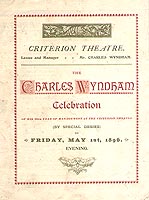 |
CHARLES WYNDHAM CELEBRATION In celebration of Wyndham's 20 years managing the Criterion Theatre, a grand evening of varied entertainment on May 1st 1896, including appearances by George Grossmith and Decima Moore in act 2 of The Critic. |
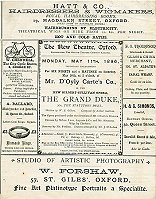 |
GRAND DUKE on tour D'Oyles Cartes "E" Company arrived in Oxford on May 11th 1896, performing The Grand Duke seven times in the week. |
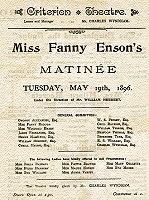 |
FANNY ENSON's MATINEE Benefit for Fanny Enson at the Criterion Theatre, May 19th 1896. Florence St.John (Rita of The Chieftain) was among the featured performers, and Lillie Langtry gave a recitation. Other names included Mr. & Mrs.Tree, Irene Vanbrugh, Charles Wyndham, Louie Freear, Nina Bouccicault and Lewis Waller. Selections from plays were interspersed with solo items. |
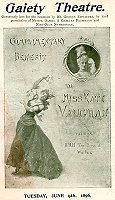 |
KATE VAUGHAN's BENEFIT Benefit for Kate Vaughan at the Gaiety Theatre, June 9th 1896. Included Trial by Jury, directed by Gilbert, who also played the Associate. Rutland Barrington was Judge; Florence St. John, the Plaintiff; Eric Lewis was Counsel and Charles Kenningham, the Defendant. W.S. Penley, then most famous for Charley's Aunt, played Foreman, a part he had taken at the Royalty Theatre in 1875 ! Among the bridesmaids and jury were many D'Oyly Carte "names", including: Florence Dysart, Walter Passmore, Edith Johnston, Emmie Owen, Florence Perry and J.J. Dallas. Francois Cellier conducted, and in the chorus was the usual mix of personalities of the day. Other highlights of the afternoon included appearances by Dan Leno, Letty Lind, Marie Tempest, and many, many others. |
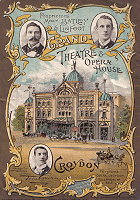 |
GRAND DUKE on tour "E" Company arrived in Croydon on June 15th 1896, where they played The Grand Duke for one week. The envelope-format programme has views of the exterior, auditorium and front-of-house areas of the Grand Theatre & Opera House. |
 |
MIKADO
/ AFTER ALL
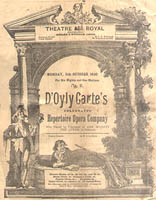
Jessie Bond appeared on stage for the last time in the third revival of The Mikado, which opened at the Savoy on July 11th 1896, although she made guest appearances in galas after this date. One of 1000 printed on 27th July, this programme is dated by hand for the following night. The production also featured Rosina Brandram of the original cast, and closed after 226 performances, on February 17th 1897. |
 |
D'OYLY
CARTE on tour
D'Oyly Carte's touring company "C" reached the Edinburgh Theatre Royal on 5th October 1896, presenting Yeomen, Gondoliers, Mikado and, at a matinee only, Iolanthe. |
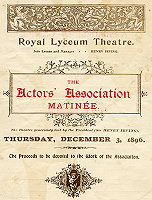 |
ACTORS' ASSOCIATION MATINEE Benefit matinee for the Actors' Association at the Lyceum Theatre, December 3rd 1896. Concluded with Trial by Jury, with Rutland Barrington as Judge. Florence Dysart appeared as Plaintiff, a role she had played in the 1884 Savoy revival. Walter Passmore was Foreman, and other Savoyards in the cast included Charles Kenningham, Charles Childerstone and Edith Johnston. Elsewhere on the bill, Henry Irving gave a recitaion and George Grossmith (Jnr.) appeared in a scene from A Night Out. |
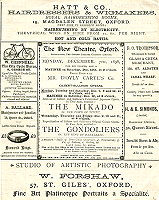 |
MIKADO on tour D'Oyles Cartes "E" Company returned to Oxford on Dec 7th 1896, performing The Mikado four times, and The Gondoliers three times in the week. Walter Summers plays Ko-Ko in this Mikado programme. |
| 1897 |
 |
HIS
MAJESTY - OPENING NIGHT
Written by F.C. Burnand and Adrian Ross, His Majesty opened at the Savoy on 20th February 1897, and featured most of D'Oyly Carte's company of regulars. This first night programme names George Grossmith as King Ferdinand - a role he only played for only four (or six, according to one source) performances, following a bad reception on opening night. He was replaced temporarily by Herbert Workman and ultimately by Henry Lytton, but the show floundered and finally closed on April 24th, after just 61 performances. |
 |
YEOMEN OF THE GUARD Programme for the first revival of Yeomen at the Savoy, which opened on 5th May 1897 and ran for just 186 performances. Richard Temple, Rosina Brandram and H.Richards (Headsman) appeared in their original parts. This is the paper version, intended for the cheaper seats. |
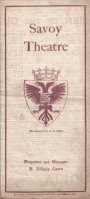 |
YEOMEN OF THE GUARD For just a few weeks during the first revival of Yeomen at the Savoy, in May 1897, Shadbolt was played by Tom Redmond. Other cast changes of note are Cory James as Leonard and Charles Childerstone as First Yeoman. |
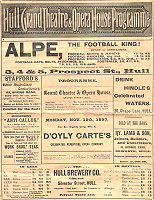 |
GONDOLIERS / MIKADO on tour During 1897 "B" Company toured with ten G&S operas (including Trial), and by the time it reached the Grand Theatre & Opera House in Hull in November there were as many as eight pieces in the repertoire at the same time. The week started with The Gondoliers ! on Mon 16th evening and ended with The Mikado !, played on both Tuesday and Saturday nights. It is interesting that as late as 1897 theatre managements still felt justified in adding exclamation marks to the titles of G&S operas, in their programmes. |
| 1898 |
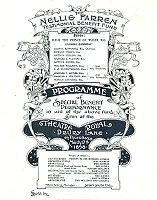 |
TRIAL BY JURY - FARREN BENEFIT Nellie Farren, of Thespis, was, by the late 90s, crippled and unable to work. The funds raised for her at this benefit at the Theatre Royal Drury Lane on March 17th 1898 would provide for her for the remainder of her life. One of the most star-studded events of the decade, the show included a performance of Trial by Jury with Gilbert himself playing the Associate, as well as the premiere of a J.M. Barrie playlet. Marie Lloyd, Ben Davies, Ellen Terry, Henry Irving, Clara Butt, Dan Leno, and many others (including a host of Savoyards) are named. |
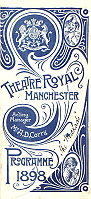 |
MIKADO on tour Programme for a "C" Company Mikado at the Theatre Royal in Manchester, 18th May 1898. Fred Billington as Pooh-Bah and George Thorne as Ko-Ko. |
 |
GONDOLIERS - FIRST REVIVAL The Gondoliers was given its first revival at the Savoy on March 22nd 1898, with only Rosina Brandram of the original cast repeating her role. There was one cast change during the 62 performance run, but this programme, dated 19th May, shows Emmie Owen as Gianetta. The revival closed on May 21st to make way for The Beauty Stone, which is advertised on the bottom inside edge. |
 |
THE BEAUTY STONE Sullivan's "romantic musical drama" The Beauty Stone was a very different beast to the typical Savoy opera. With treacle-like book and lyrics by Arthur Wing Pinero and J. Comyns Carr it tickled the taste of neither critics nor public, and closed just 50 performances after its May 28th 1898 opening. This programme for Sullivan's biggest flop at the Savoy, is dated 1st June, and was printed in a small edition of just 300. Familiar names in the cast include Henry Lytton, Rosina Brandram and Walter Passmore. |
 |
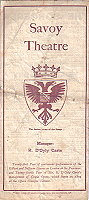
THE SORCERER 21st Birthday Thursday November 17th 1898 marked the 21st anniversary of the opening night of The Sorcerer. To mark the occasion D'Oyly Carte produced one of his souvenir booklets, presumably available only to those present on the night. It includes photographs of all the leading characters in all the productions to date. |
 |
THE SORCERER / TRIAL Regular programme for the 2nd Sorcerer revival, dated 5th December. The opera had opened on Sept 22nd 1898, and ran for 102 performances, in tandem with Trial by Jury, closing on New Year's Eve. At this point in the run Charles Childerstone was the Defendant with Henry Franckiss as the Associate, and Jones Hewson was Sir Marmaduke. |
| 1899 |
 |
THE LUCKY STAR Ivan Caryll's The Lucky Star opened at the Savoy on Jan 7th 1899, and featured many of the usual D'Oyly Carte regulars. This programme, dated 15th March, includes all the first cast with the exception of Fred Wright Jnr, who had replaced Sydney Paxton as Sirocco. |
 |
THE LUCKY STAR This Lucky Star programme, dated 4th April 1899 shows two cast changes from opening night. As well as Fred Wright Jnr the cast includes Henry Claff as Kedas, the Chief of Police, replacing Frank Manning. The show closed on 31st May after 143 performances. |
 |
PYGMALION & GALATEA For six nights, from May 15th 1899, Janette Steer and her Company performed at the Royalty Theatre in Glasgow. Most nights the cast gave La Tosca by Victorien Sardou, but the repertoire also included Pygmalion & Galatea. This May 18th programme shows Miss Steer and Frank Dyall in Gilbert's title roles. |
 |
PINAFORE / TRIAL With only Richard Temple in his original role, HMS Pinafore was given its second revival (with Trial By Jury) on June 6th 1899. The production ran for 174 performances, closing on 25th November. This programme was printed on 11th October. |
 |
SAN TOY Rutland Barrington, originator of so many roles at the Savoy, left the D'Oyly Carte company in 1896, to work with other producers. On 21st October 1899, he created the part of Yen How in San Toy, Harry Greenbank and Adrian Ross' "Chinese Musical". Although Barrington left the cast after a time, the show ran for 778 performances, closing on 14th December 1901. Many of the original cast are named in this undated programme. |
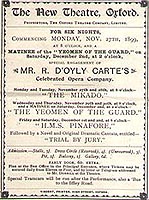 |
PINAFORE / TRIAL on tour D'Oyly Carte's "E" Company toured the UK in 1899, reaching the New Theatre in Oxford on 27th November and staying for six nights. This programme for HMS Pinafore and Trial by Jury was used on 1st and 2nd December. Although the programme stated that Pinafore was, "now playing to crowded houses at the Savoy", it had in fact closed a week earlier. |
 |
ROSE OF PERSIA - OPENING NIGHT Sullivan's comic opera, The Rose of Persia, with words by Basil Hood, opened at the Savoy on November 29th 1899. The first night programme is dated in full, and includes the fact that "on this occasion the opera will be conducted by the composer". This would be Sir Arthur's final appearance in the pit at the Savoy. |
 |
ROSE OF PERSIA The Rose of Persia's London run closed after 213 performances on June 29th 1900. This programme dates from 14th December. There was no curtain-raiser during the run. Price reduced |
| 1900 |
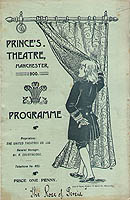 |
ROSE OF PERSIA Even while London audiences were still enjoying The Rose of Persia, D'Oyly Carte sent it around the UK. The tour opened in Brighton on April 16th 1900, and reached the Prince's Theatre in Manchester on 7th May, where it stayed for one week. |
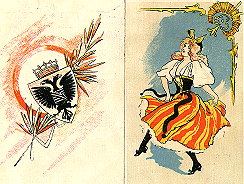 |
D'OYLY CARTE TOUR FLYER D'Oyly Carte "C" company played their last week of 1900 at the New Grand Theatre in Woolwich, S.E. London. This unusual herald for the week commencing Dec 10th mentions only The Mikado, and gives a list of company members inside. Front and back cover bear chromolithographs of the Savoy crest and a dancing girl, possibly inspired by The Gondoliers. |
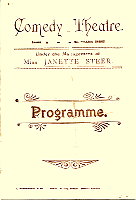 |
PYGMALION & GALATEA / COMEDY & TRAGEDY These two Gilbert plays were revived as a double bill at the Comedy Theatre on June 7th 1900, with Fuller Mellish and Janette Steer in the lead roles of both pieces. |
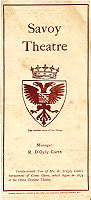 |
PIRATES OF PENZANCE / THE OUTPOST Pirates was given its second revival at the Savoy, opening on June 30th 1900. Despite a short run of just 127 performances, there were a number of cast changes during the run. The work was preceded by The Outpost, adapted from the German piece by Korner. |
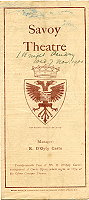 |
PATIENCE - OPENING NIGHT The first revival of Patience opened at the Savoy on November 7th 1900, and ran for 150 performances until April 20th 1901. There was no curtain raiser on opening night. |
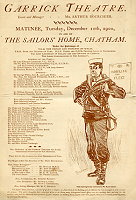 |
SAILOR'S HOME MATINEE On Tues December 11th 1900 the Garrick Theatre hosted a benefit matinee in aid of the Sailor's Home in Chatham, Kent. The usual mix of playlets and variety entertainment, George Grossmith performed some humorous songs and selections, and his brother Weedon appeared in his own comedy, A Commission. Dan Leno joined other great names of the day, including H.B. Irving, Martin Harvey and Hayden Coffin. |
 |
PATIENCE / PRETTY POLLY Sir Arthur Sullivan, Richard D'Oyly Carte and Queen Victoria all died during the short run of this revival, and as a mark of respect the theatre was kept dark for a period to mark each of these events. This programme is dated for 28th December, and includes details of the Basil Hood / Francois Cellier curtain-raiser, Pretty Polly. |
| 1901 |
 |
POOH-BAH ADVERTISING SCRAP Probably produced during the first run of The Mikado, Pooh-Bah holds a tin of Pedigree Cavendish Flake Cut Tobacco, marketed by John Player from April 1901 (if not earlier). The 9" high scrap appears to represent an actual actor (probably Fred Billington) dressed in a close approximation of Wilhelm's costume. Could this be reverse product placement ? Did a clever advertising man wish "deference due to a man of pedigree" to become associated with the tobacco when audience members heard the line ? |
 |
THE EMERALD ISLE - OPENING NIGHT Sullivan's last opera, The Emerald Isle premiered at the Savoy on April 27th 1901, the score having been completed by Edward German. The first night programme is dated in full, and includes the fact that "on this occasion the opera will be conducted by Mr. German". The book for the piece was by Basil Hood. |
 |
THE EMERALD ISLE The Emerald Isle ran for 205 performances, closing on November 9th. This programme was issued on 27th October. Lower class version printed on paper. During the run the management of the Savoy, and indeed the Company, was taken over by William Greet. |
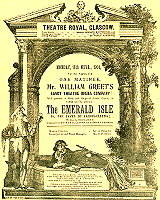 |
THE EMERALD ISLE The Emerald Isle toured under the management of William Greet's "Savoy Theatre Opera Company". This programme is from the week of November 18th 1901, when the first tour had reached Glagow's Theatre Royal. |
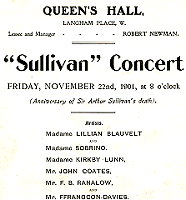 |
SULLIVAN ANNIVERSARY CONCERT On Friday 22nd Nov 1901, the first anniversary of the death of Sullivan, Henry Wood conducted a memorial concert at the Queen's Hall in London. The Golden Legend was followed vy scenes from Act 2 of Ivanhoe, performed by Mr Ffrangcon-Davies, who had appeared in the original cast of the opera, with Madame Kirkby Lunn and others. The programme includes notes on both pieces, libretti, and a brief biography of Sullivan. |
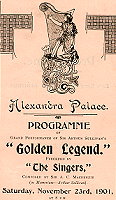 |
SULLIVAN ANNIVERSARY CONCERT The following night, Sat Nov 23rd 1901, the Alexandra Palace in North London hosted another performance of The Golden Legend. The evening also included Sir A. C. Mackenzie's piece, The Singers, written in memoriam of Sir Arthur, and conducted on this occasion by the composer. The programme includes the words to Longfellow's poem. |
 |
IOLANTHE FIRST REVIVAL- OPENING NIGHT The first revival of Iolanthe opened at the Savoy on December 7th 1901, and ran for 113 performances until March 29th 1902. This programme is dated for the opening night, Dec 7th, although it was printed on the previous day. |
| 1902 |
 |
IOLANTHE / WILLOW PATTERN This "cheap seats" paper programme for the first Iolanthe revival was printed on 7th March, and includes details of The Willow Pattern, a curtain raiser by Basil Hood and Cecil Cook. |
 |
RIGNOLD BENEFIT The testimonial benefit for William Rignold, at the Lyric Theatre on December 5th 1902, was a chance for London's theatre community to pay tribute. Highlight of the afternoon was a performance of Trial By Jury, at which Gilbert himself played the Associate. Others in the cast included Rutland Barrington, Charles Childerstone, C. Hayden Coffin, Evie Greene & Lionel Monckton. Cox & Box was also on the bill, featuring Richard Temple, Powis Pinder and Vernon Cave. |
 |
MERRIE
ENGLAND
Edward German's first solo work for the Savoy, Merrie England, with libretto by Basil Hood, opened on 2nd April 1902, running for 120 performances before setting out on tour. The show returned to the Savoy on November 24th and ran until January 17th 1903. This programme, dated 6th December, features a few actors not named in Rollins and Witts: M.R Morand was Sila Simkins, Lena Leibrandt was Kate, and Mr. C. Earldon was a soldier. It includes an announcement that German would conduct the 250th performance, on December 10th. |
 |
WATER BABIES Rutland Barrington adapted Charles Kingsley's classic children's book for the stage in 1903, even writing some of the lyrics. Music was by three composers, including the late Alfred Cellier. The piece opened at the Garrick Theatre on 18th December 1902, and ran for just 100 performances. |
| 1903 |
 |
A PRINCESS OF KENSINGTON - OPENING NIGHT A Princess of Kensington opened on January 22nd 1903, with a cast including Henry Lytton, Walter Passmore and Rosina Brandram, making her final appearance at the Savoy. Edward German is named as conductor in this first night programme. The words were once again by Basil Hood. Arthur Boielle played Sir James Jellico at the first performance, and Edward Royce did not appear, contrary to the listing in Rollins & Witts. |
 |
A PRINCESS OF KENSINGTON A Princess of Kensington proved not to be so popular as Merrie England, closed on May 16th 1903 after just 115 performances. This was the final original comic opera produced at the Savoy, which was dark for nearly nine months before reopening under new management on Feb 10th 1904. |
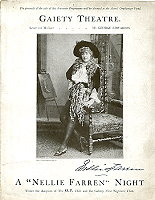 |
NELLIE FARREN NIGHT Nellie Farren's last public appearance was at a "Nellie Farren Night" at the Gaiety Theatre on April 8th 1903. A performance of The Toreador was followed by The Linkman, a special revue of old Gaiety hits written by, and featuring, George Grossmith Jnr, with Ethel Sydney made up as Nellie. At the end of the evening Farren made a speech from the stage. She died, aged 58, just a year later, on April 28th 1904. |
 |
PRINCESS OF KENSINGTON on tour Following the London run, Greet's A Princess of Kensington company started a short tour of the UK, but the piece was soon dropped in favour of Merrie England when audiences were not so large as expected. One of the first bookings was at the Princess of Wales' Theatre in Kennington, South London, where it played for seven performances from May 25th 1903. |
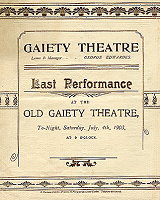 |
GAIETY THEATRE FAREWELL Programme for the final performance at the "Old" Gaiety Theatre on July 4th 1903. The Linkman - or Gaiety Memories was performed again, with a cast which included George Grossmith Jnr, Florence St. John, Rutland Barrington, Richard Temple, J. J. Dallas and many other "names" of British theatre. |
 |
GONDOLIERS & YEOMEN D'Oyly Carte "C" Company reached Glasgow's Royalty Theatre on 17th August 1903. This programme is for the Wed and Thurs performances of Gondoliers and Yeomen. Casts include C.H. Workman, Fred Billington and Jessie Rose, but Vittoria is played by Ruby Lingard, appearing with the company four months earlier than recorded by Rollins and Witts. Amy Royston was also in an unexpected role, as Inez. |
 |
GROSSMITH IN BATTERSEA As late as 1903 George Grossmith was still giving his recitals, as evidenced by this programme for the Battersea Polytechnic of October 10th. As well as details of GG's performance, listing all the songs, it also includes many pages of future events at the venue, such as Maskelyne & Cooke's "animated photographs" and lectures on paper making and politics ! |
 |
THE TEMPEST Shakespeare's The Tempest at Royal Court Theatre, London. This production used Sullivan's Intoduction, Prelude, Entr'acte and Dance of the Nymphs and Reapers. It opened on 26th October 1903 and closed after fifty performances, on 5th December. |
| 1904 |
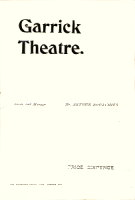 |
HARLEQUIN & THE FAIRY'S DILEMMA Gilbert's play Harlequin & the Fairy's Dilemma (Harlequin was dropped from the title after a few days) opened at the Garrick on May 3rd 1904. Described as "an original domestic pantomime", the dances were arranged by John D'Auban but the piece closed on 22nd July, after just 90 performances. This programme is from early in the run, before the title change. |
| 1905 |
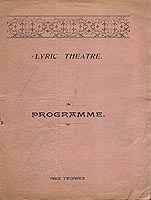 |
THE TALK OF THE TOWN A musical comedy by Seymour Hicks, with music by Herbert E. Haines, The Talk of the Town opened at the Lyric Theatre on 5th January 1905 and ran for just 100 performances. The cast included many D'Oyly Carte stalwarts, including Walter Passmore, Henry Lytton, Powis Pinder, Robert Evett, Charles Childerstone and Rudolf Lewis. |
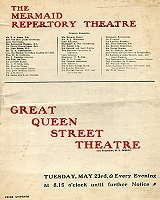 |
THE PALACE OF TRUTH Revival of Gilbert's play at the Great Queen Street Theatre, which opened May 23rd 1905, this programme dated two days later. The production, by the Mermaid Repertory Theatre company, featured W.H. Kemble and Mrs Theodore Wright. |
| 1906/7 |
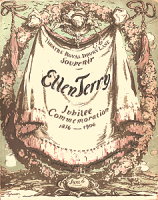 |
TRIAL BY JURY Souvenir programme for the Ellen Terry Jubilee Commemoration at the Theatre Royal Drury Lane, June 12th 1906. This hard-back brochure gives full details of all the events including Trial By Jury with Gilbert himself as Associate. As well as familiar Savoyards in the solo parts, the production included many famous faces in the jury (e.g. Arthur Conan Doyle) and in the crowd (e.g. Rosina Brandram). |
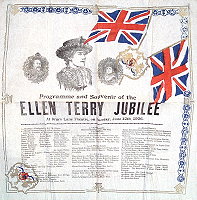 |
TRIAL BY JURY Rare tissue paper programme for the Ellen Terry Jubilee celebration. Main cast members are included for all the major events, which are listed in a different order to that in the official hard-back brochure. There is also an important cast change for Trial By Jury with Marie Tempest as Plaintiff rather than Ruth Vincent, possibly suggesting that this was an unofficial souvenir printed before finalisation of the event. |
 |
1st REP SEASON at Savoy Theatre December 1906 to August 1907: If title is a link, a prog is in stock. Alternate casts, colours and original prices, if any, are detailed lower on the same page.
|
| 1908/9 |
 |
2nd REP SEASON at Savoy Theatre April 1908 to March 1909: If title is a link, a prog is in stock. Alternate casts, colours and original prices, if any, are detailed lower on the same page.
|
 |
SAVOY TICKET 1908 Ticket for a balcony stall, May 20th 1908, a performance of The Mikado. |
| 1910 |
 |
FALLEN FAIRIES Gilbert's last musical play was, perhaps fittingly, a Savoy opera. Fallen Faries, a musical adaptation of Gilbert's 1873 play,The Wicked World, had music by Edward German, and opened on 15th Dec 1909. By the time this programme was printed, on 17th January, Amy Evers (misprinted "Evans") was playing Selene. Love Rules the World had also been interpolated, despite Gilbert's attempt to block the song with a court injuction. The piece closed on January 29th, after just 51 performances. |
 |
CHARACTER HERALDS Clicking on the image on the left will lead to a page detailing all the known examples of the pictorial herald cards used by the D'Oyly Carte in the 1920s and 30s, as well as a summary of their history. Many different examples are for sale. |